
Antianginal Drugs
Angina types
Classical (stable): predictable, exertion/emotion-provoked, relieved by rest. FIXED atherosclerotic narrowing of conducting vessels. Attack → ↑LV end-diastolic pressure(5→25mmHg) → subendocardial crunch (subendocardium perfused ONLY in diastole → worsens own ischemia). Variant (Prinzmetal): unpredictable, rest/sleep, coronary VASOSPASM. Unstable angina: plaque rupture+platelet deposition, HIGH MI RISK — managed with antiplatelets/revascularization, not just antianginals.
Antianginals relieve symptoms, do NOT alter CAD course (aspirin/statins/ACE-I do that).
Nitrates
Mechanism: denitrated in vascular smooth muscle → NO → ↑soluble guanylyl cyclase → ↑cGMP → PKG → dephosphorylates MLCK → myosin can’t engage actin → relaxation. (SAME endpoint pathway as CCBs, different starting point.)
Preload reduction = dominant mechanism in classical angina: veins>arteries dilated → ↓venous return → ↓EDV/EDP → (Laplace) ↓wall tension → ↓O2 demand + RESTORES diastolic perfusion gradient → relieves subendocardial crunch directly. Mild afterload reduction too.
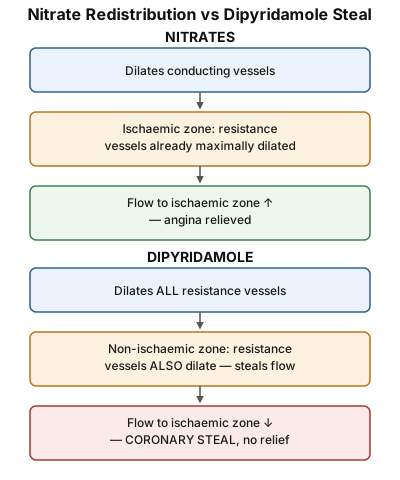
Selective conducting-vessel dilatation = PRINCIPAL mechanism in VARIANT angina (directly counters spasm); redistributes flow toward ischemic zone (its resistance vessels already maxed out by autoregulation) without ↑total coronary flow.
ADRs: headache(meningeal dilation, tolerance develops) · flushing/postural hypotension+reflex tachycardia(worse standing+alcohol) · methemoglobinemia(insignificant unless severe anemia).
Tolerance: rapid if CONTINUOUS presence, wears off rapidly drug-free. Clinically insignificant with intermittent SL use; MATTERS with continuous IV/transdermal/SR oral → need 8-10h nitrate-free interval daily. Dependence: real — abrupt stop → coronary/peripheral spasm, MI, sudden death. Taper.
Sildenafil/PDE-5i + nitrate = DANGEROUS potentiation (severe hypotension/MI/death) — CI within 24h.
| Drug | Route | Duration | Note |
|---|---|---|---|
| GTN | SL, 1-2min onset | 10-30min | ~90% first-pass if swallowed; also spray/patch(24h,tolerance-limited to 8-10h/day)/IV |
| Isosorbide dinitrate | SL or oral | 20-40min SL | Marked variable first-pass orally |
| Isosorbide mononitrate | Oral | 6-10h | Active metabolite of ISDN, little first-pass, HIGH consistent bioavailability |
Uses: ACS(↓preload+counter spasm, NO mortality benefit, symptomatic only) · Acute LVF/CHF(venous pooling, IV GTN=emergency drug of choice) · biliary colic/esophageal spasm · cyanide poisoning (nitrite→methemoglobin→binds CN→cyanomethemoglobin→+Na thiosulfate→thiocyanate, renally excreted).
β-blockers
↓HR+contractility+BP by DIRECT cardiac action — NO coronary dilation (may even slightly ↓ total flow, β2 blockade). ONLY antianginal class proven to prolong life in CAD → 1st-line unless CI. Cardioselective(atenolol/metoprolol) PREFERRED over non-selective(propranolol) — non-selective leaves α-mediated coronary constriction unopposed → WORSENS variant angina. Abrupt stop→severe angina/MI.
UA/NSTEMI: β-blocker used AFTER nitrate/CCB started (prevent unopposed-α vasospasm worsening).
CCBs
Mechanism: blocks L-type Ca²⁺ channels directly (vs nitrates’ NO/cGMP route — same endpoint, different start).
DHPs (amlodipine): mainly vasodilator, minimal cardiac depression — good for vasospastic component. Short-acting nifedipine AVOIDED (sympathetic surge→↑mortality). Amlodipine=ONLY CCB safe in CHF. Verapamil/diltiazem: DIRECT cardiac depression (↓contractility+O2 demand), less reflex stim → less likely to worsen ischemia BUT avoid in CHF/low EF, NEVER combine with β-blocker (additive SA/AV depression → heart block risk).
NOT used in evolving MI; no proven mortality benefit post-MI (unlike β-blockers) — verapamil/diltiazem used post-MI only if β-blocker CI.
Combinations
| Combo | Rationale |
|---|---|
| β-blocker + long-acting nitrate | Each fixes other’s downside: β-block↓nitrate-reflex-tachycardia; nitrate↓β-blocker-induced ventricular dilation; nitrate corrects β-blocker’s ↓total coronary flow |
| β-blocker + slow DHP | Same complementary logic, good if vasospasm component present |
| Nitrate + CCB | Nitrate↓preload, CCB↓afterload+↑coronary flow — supra-additive, good in severe vasospastic/β-blocker-CI |
| ALL THREE | Severe resistant classical angina |
NEVER verapamil/diltiazem + β-blocker (repeat: heart block risk) — single most important combination rule here.
Newer/2nd-line drugs
Nicorandil: DUAL mechanism — opens ATP-K+ channels (hyperpolarize/relax) AND NO donor (like nitrates) → BOTH arterial+venous dilation (afterload+preload↓). NO nitrate-type tolerance. Simulates “ischemic preconditioning” (mito-K-ATP) = cardioprotective. 2nd-line add-on.
Trimetazidine: NO haemodynamic effect at all (HR/BP unchanged rest+exercise) — metabolic shift: inhibits LC3-KAT → ↓fatty acid oxidation, ↑glucose oxidation (glucose needs LESS O2/ATP than fatty acid) → ↓O2 demand. Add-on only.
Ranolazine: inhibits late-INa in ischemic myocardium → indirectly ↓Ca²⁺ overload (via Na/Ca exchanger) → cardioprotective, NO haemodynamic change.
Ivabradine: “PURE” HR-lowering — blocks SA node “funny” (If) current (phase 4 slope) → ↓HR ONLY, NO negative inotropy, NO other electrophysiological effect. Alternative when β-blockers CI/not tolerated.
Dipyridamole = FAILURE example: pharmacologically POWERFUL coronary dilator (blocks adenosine reuptake) but CLINICALLY INEFFECTIVE — dilates ALL resistance vessels indiscriminately including NON-ischemic zone → CORONARY STEAL (diverts flow AWAY from ischemic zone). Now used only as adjunct antiplatelet, NOT antianginal.
Clinical relevance
“Vasodilator” ≠ one category with one outcome. Dipyridamole (indiscriminate resistance-vessel dilation) WORSENS ischemia via steal; nitrates (selective conducting-vessel dilation) HELP by redirecting flow. WHERE in the vascular tree a drug acts matters as much as WHETHER it dilates.
Angina Pectoris — The Problem Antianginal Drugs Solve
Angina is pain from a mismatch between myocardial oxygen supply and demand, produced by accumulating ischaemic metabolites. Two forms matter pharmacologically, because they call for genuinely different drug logic:
- Classical (stable) angina — predictably provoked by exertion, emotion, or a heavy meal, and relieved by rest. The underlying lesion is fixed atherosclerotic narrowing of the larger conducting coronary arteries — blood flow simply cannot rise to meet increased demand. During an attack, the ischaemic left ventricle’s end-diastolic pressure rises sharply (roughly 5 to 25 mmHg), producing a “subendocardial crunch” that further compromises the very layer most dependent on diastolic perfusion, worsening the ischaemia it’s caused by.
- Variant (Prinzmetal/vasospastic) angina — unpredictable, occurring at rest or during sleep, caused by recurrent localized coronary vasospasm, sometimes superimposed on underlying atherosclerosis.
Unstable angina, a distinct and more dangerous entity, usually reflects rupture of an atheromatous plaque with platelet deposition and progressive occlusion — a high-risk state for impending myocardial infarction, managed with a different drug emphasis (antiplatelet therapy, revascularization) rather than antianginal drugs alone.
Antianginal drugs relieve symptoms and improve exercise tolerance but do not alter the underlying course of coronary artery disease — that modifying role belongs to aspirin, statins, and ACE inhibitors instead, a distinction worth holding onto since it shapes why antianginal therapy is always combined with cardioprotective drugs rather than used alone.
Three major drug classes are used, each reducing myocardial oxygen demand or improving supply through a genuinely different primary mechanism — which is exactly why they combine so effectively.
Organic Nitrates
Mechanism. All organic nitrates share one core action: they are enzymatically denitrated within vascular smooth muscle to release nitric oxide, which activates soluble guanylyl cyclase, raising cGMP and — through cGMP-dependent protein kinase — dephosphorylating myosin light chain kinase. Reduced active MLCK means myosin cannot engage actin, and the muscle relaxes. This is the same NO/cGMP pathway calcium channel blockers converge on from a different starting point (see below), which is why the two classes are mechanistically complementary rather than redundant.
Preload reduction is the dominant benefit in classical angina. Nitrates dilate veins more than arteries, pooling blood peripherally, reducing venous return, and lowering end-diastolic ventricular size and pressure — which, by the Laplace relationship, directly reduces the wall tension the ventricle must generate and therefore its oxygen consumption. Critically, the fall in end-diastolic pressure also restores the pressure gradient across the ventricular wall that drives diastolic subendocardial perfusion, directly relieving the subendocardial crunch described above. A milder afterload-reducing effect (arteriolar dilatation, modest fall in total peripheral resistance) contributes further, though less centrally.
Selective conducting-vessel dilatation and redistribution. Nitrates preferentially dilate the larger, angiographically visible conducting coronary arteries rather than the resistance arterioles — this matters because in an ischaemic zone, autoregulation has already maximally dilated the local resistance vessels, while non-ischaemic zones retain their tone. The net effect favourably redistributes flow toward the ischaemic region without meaningfully raising total coronary flow. This redistribution is the principal mechanism benefiting variant angina specifically (directly counteracting coronary spasm), whereas in classical angina the primary benefit is the peripheral preload effect described above, with improved ischaemic blood flow as a secondary contributor.
Adverse effects follow directly from vasodilatation: throbbing headache (meningeal vessel dilatation, with some tolerance developing on continued use), flushing, and postural hypotension with reflex tachycardia (worsened by standing still and alcohol, mitigated by lying down). Methaemoglobinaemia is not clinically significant at ordinary doses but can matter in severe pre-existing anaemia.
Tolerance develops rapidly (within the same dosing period) if nitrate is continuously present, but wears off just as rapidly once the body is drug-free — clinically insignificant with intermittent sublingual use for acute attacks, but genuinely limiting for continuous IV infusion, transdermal patches, or sustained-release oral formulations, which is why a daily nitrate-free interval (typically 8–10 hours) is the standard way to preserve efficacy. Dependence is real too — abrupt withdrawal after prolonged exposure has caused coronary/peripheral vasospasm, MI, and sudden death, so withdrawal must always be gradual.
Drug interaction worth flagging specifically: PDE-5 inhibitors (sildenafil and related drugs) cause dangerous, sometimes fatal, potentiation of nitrate-induced hypotension — nitrates are contraindicated in a patient who has taken sildenafil within the preceding 24 hours, and this cuts both ways in prescribing decisions.
Individual nitrates differ mainly in absorption/metabolism kinetics rather than mechanism:
| Drug | Route/onset | Duration | Notes |
|---|---|---|---|
| Glyceryl trinitrate (GTN) | Sublingual, acts in 1–2 min | 10–30 min | ~90% first-pass metabolized if swallowed — sublingual route bypasses this; also available as spray, transdermal patch (24h steady delivery, tolerance-limited to 8–10h daily), and IV infusion |
| Isosorbide dinitrate | Sublingual or oral | 20–40 min (sublingual); longer orally | Pronounced, variable first-pass metabolism orally |
| Isosorbide mononitrate | Oral | 6–10 hr | The active metabolite of isosorbide dinitrate; little first-pass metabolism, high and consistent bioavailability — a genuine pharmacokinetic improvement over its parent |
Uses beyond routine angina prophylaxis: acute coronary syndromes (reduces preload and counters coronary spasm, though without demonstrated mortality benefit in trials — the benefit is symptomatic); acute LVF/CHF (venous pooling reduces preload, improving pulmonary congestion — IV GTN is the emergency preparation of choice); biliary colic and oesophageal spasm (smooth muscle relaxation); and, notably, cyanide poisoning — nitrite-induced methaemoglobin has high affinity for the cyanide radical, forming cyanomethaemoglobin, which is then converted with sodium thiosulfate to the far less toxic, renally excreted thiocyanate.
β-Adrenergic Blockers
β-blockers reduce myocardial oxygen demand by direct cardiac action — reduced heart rate, contractility, and blood pressure together lower cardiac work — without dilating coronary or other vessels at all; if anything, blockade of dilator β2 receptors slightly reduces total coronary flow. Despite this, β-blockers are the only antianginal drug class shown to prolong life expectancy in coronary artery disease patients, and current guidelines place them as first-line in stable angina unless specifically contraindicated. Cardioselective agents (atenolol, metoprolol) are preferred over non-selective ones (propranolol) specifically because non-selective blockade leaves α-receptor-mediated coronary vasoconstriction unopposed — the same vasomotor-reversal-of-Dale logic seen elsewhere in this system — which can actively worsen variant angina’s underlying vasospasm. Abrupt discontinuation after chronic use can precipitate severe angina or MI (receptor upregulation, as covered under the Adrenergic System).
In unstable angina/NSTEMI, β-blockers are used routinely but only after a nitrate or calcium channel blocker has been started to counteract any coronary vasospasm — giving a β-blocker first risks worsening vasospasm through the same unopposed-α mechanism.
Calcium Channel Blockers
Mechanism, converging on the same relaxation pathway as nitrates from a different starting point: CCBs block voltage-gated L-type calcium channels, reducing calcium entry into vascular and cardiac muscle cells directly, rather than acting through the NO/cGMP cascade.
All three CCB subclasses have antianginal value, but their profiles diverge meaningfully:
- Dihydropyridines (amlodipine and others) — predominantly vasodilator, minimal direct cardiac depression; particularly useful where coronary vasospasm is a component of classical angina. Short-acting formulations (regular nifedipine) are specifically avoided — the sharp sympathetic surge accompanying each rapidly-absorbed dose has been linked to increased mortality in MI patients, a risk not shared by slow-acting dihydropyridines. Amlodipine specifically is the only CCB shown safe (not mortality-increasing) in heart failure.
- Verapamil and diltiazem — genuine direct cardiac depressant action (reduced contractility and reduced O2 demand), with correspondingly less reflex sympathetic stimulation and less risk of aggravating ischaemia than dihydropyridines — but for the same reason, they must be avoided in heart failure or low ejection fraction, and must never be combined with a β-blocker (additive depression of SA/AV nodal conduction, risking serious bradyarrhythmia or heart block).
CCBs are not used in evolving MI, and — unlike β-blockers — have not demonstrated a mortality or outcome benefit post-MI; verapamil/diltiazem may still be used post-MI specifically when β-blockers are contraindicated. Other CCB uses relevant here: hypertension (dihydropyridines, verapamil, diltiazem all first-line, see Antihypertensives), PSVT and ventricular-rate control in supraventricular arrhythmias (verapamil, diltiazem), hypertrophic cardiomyopathy (verapamil’s negative inotropy is beneficial here), and Raynaud’s phenomenon (dihydropyridines).
Combining Antianginal Drug Classes
Because the three classes act through genuinely different primary mechanisms, they combine supra-additively rather than merely additively — and specific pairings are chosen for specific reasons, not interchangeably:
- β-blocker + long-acting nitrate: rational because each corrects a shortcoming of the other — the β-blocker blocks nitrate-induced reflex tachycardia; the nitrate’s venodilatation counteracts the β-blocker’s tendency to increase ventricular volume/dilatation; the nitrate’s redistributive effect counters the β-blocker’s tendency to reduce total coronary flow.
- β-blocker + slow-acting dihydropyridine achieves similar complementary benefits, and is specifically preferable when coronary vasospasm is a meaningful component of the classical angina.
- Nitrate + CCB: nitrates primarily reduce preload; CCBs primarily reduce afterload and improve coronary flow — concurrent use can lower cardiac work and improve perfusion beyond what either achieves alone, particularly valuable in severe vasospastic angina or when β-blockers are contraindicated.
- All three together is reserved for severe, resistant classical angina, exploiting the genuinely distinct primary mechanisms for supra-additive benefit.
Verapamil/diltiazem should never be combined with a β-blocker in any of these regimens — this restriction is worth repeating because it is the single most consequential combination rule in this drug class, given the shared risk of severe bradycardia/heart block.
Newer and Second-Line Antianginal Drugs
Nicorandil — a dual-mechanism drug: it opens ATP-sensitive K+ channels (hyperpolarizing and relaxing smooth muscle) and acts as an NO donor like the nitrates, producing combined arterial and venous dilatation (both afterload and preload reduction) without significant effect on cardiac contractility or conduction. Unlike organic nitrates, it does not develop the same tolerance. Its channel-opening action on mitochondrial KATP channels is believed to simulate “ischaemic preconditioning” — brief prior ischaemia-reperfusion episodes conferring protection against subsequent severe ischaemia — giving nicorandil a plausible cardioprotective role beyond symptom relief. Second-line, generally used as an add-on when other classes provide inadequate control.
Trimetazidine — a genuinely different kind of antianginal drug: it has no haemodynamic effect at all (no change in heart rate or BP, at rest or with exercise) and instead works by shifting myocardial metabolic substrate preference. By inhibiting long-chain 3-ketoacyl-CoA thiolase, it reduces fatty acid oxidation and favours glucose oxidation — since fatty acid oxidation requires more oxygen per ATP generated than glucose oxidation, this substrate shift reduces myocardial oxygen requirement for the same energy output, improving ischaemic tolerance without touching any conventional haemodynamic parameter. Used as an add-on when nitrates/β-blockers/CCBs provide inadequate control.
Ranolazine — inhibits the late inward sodium current in ischaemic myocardium, which indirectly reduces pathological calcium entry via the Na+/Ca2+ exchanger; the resulting reduction in calcium overload has a genuine cardioprotective effect independent of any heart-rate or blood-pressure change, making it useful as add-on therapy without haemodynamic interaction concerns.
Ivabradine — a “pure” heart-rate-lowering drug, blocking the cardiac pacemaker “funny” (If) current in SA nodal cells that determines the slope of phase 4 diastolic depolarization. Because this is its only significant action, it lowers heart rate — and thereby myocardial oxygen demand — without any negative inotropic effect and without the other electrophysiological effects β-blockers carry, making it a genuine alternative specifically for patients who cannot tolerate or are contraindicated for β-blockers.
Dipyridamole is worth knowing specifically as a failure, not a therapeutic option: it is pharmacologically a powerful coronary vasodilator (by blocking adenosine reuptake, potentiating this local ischaemia-signalling mediator) but is clinically ineffective for angina — because it dilates resistance vessels indiscriminately, including in non-ischaemic zones, it diverts blood flow away from the already-compromised ischaemic region entirely (the coronary steal phenomenon), the opposite of what nitrates achieve through their selective conducting-vessel action. Dipyridamole’s actual clinical role today is as an adjunct antiplatelet drug, not an antianginal.
Clinical Relevance
The coronary steal phenomenon and nitrates’ selective conducting-vessel action are worth holding as a paired contrast, because they demonstrate that “vasodilator” is not a single pharmacological category with a single predictable clinical outcome — a drug that dilates coronary resistance vessels indiscriminately (dipyridamole) can make ischaemia worse by stealing flow from the exact region that needs it, while a drug that preferentially dilates conducting vessels (nitrates) redirects flow toward the ischaemic zone specifically. The lesson generalizes: in a fixed, non-uniform obstruction, where a drug acts within the vascular tree matters as much as whether it dilates at all.
Diagram 1 — Nitrate Redistribution vs Dipyridamole Coronary Steal
What to draw: Two parallel columns tracing what happens to blood flow in the ischaemic zone specifically — nitrates (selective conducting-vessel dilatation, ischaemic-zone resistance vessels already maximally dilated by autoregulation, net flow increase there) versus dipyridamole (indiscriminate resistance-vessel dilatation, non-ischaemic zone competes for and wins flow, net flow decrease in the ischaemic zone — coronary steal).
Labelling requirements: the diagram’s entire point depends on distinguishing which vessels each drug dilates — conducting vessels (nitrates) versus resistance vessels everywhere (dipyridamole) — so this distinction must be named explicitly at the first box of each column, not left implicit.
Common exam-marking mistakes:
- Describing dipyridamole as simply “a weaker coronary dilator” than nitrates — it is pharmacologically a more powerful dilator; its failure is about where it dilates, not how much.
- Missing that ischaemic-zone resistance vessels are already near-maximally dilated by local autoregulation before any drug is given — this is the reason nitrates can only help by acting on conducting vessels instead, and the reason dipyridamole’s resistance-vessel action has nothing left to add locally while still diverting flow elsewhere.
Diagram 2 — Subendocardial Crunch in Classical Angina
What to draw: A cross-section of the left ventricular wall during an anginal attack, showing the subendocardial zone specifically, with end-diastolic pressure labelled at rest (~5 mmHg) versus during ischaemia (~25 mmHg), and an arrow showing how the resulting pressure gradient reversal compromises diastolic subendocardial perfusion specifically (the layer that is only perfused during diastole).
Labelling requirements: label explicitly that the subendocardium is perfused only during diastole (unlike the rest of the myocardium) — this single anatomical fact is what makes it the specific casualty of the pressure rise, and is the reason nitrate-induced reduction in end-diastolic pressure directly relieves this mechanism rather than acting on the ischaemia generally.
Common exam-marking mistakes:
- Treating the pressure rise as simply “worse ischaemia” without naming the specific diastolic-perfusion mechanism it disrupts — the marks are tied to explaining why subendocardial tissue specifically is vulnerable, not just that pressure rises.
Long Essays (2)
Short Essays (1)
Essays (2)
Short Notes (3)
Short Answers (21)
My Sticky Notes
Personal revision notes, mnemonics and reminders.
