
Skeletal Muscle Relaxants
Classification
Act at 3 levels: NMJ/muscle fibre (neuromuscular blockers, dantrolene) OR centrally (spinal/supraspinal). NMJ blockers = surgical paralysis. Central relaxants = tone reduction without abolishing voluntary movement.
Neuromuscular blockers
Competitive (non-depolarizing) — d-TC type: affinity WITHOUT intrinsic activity, occupies NM receptor, blocks ACh action. Surmountable (↑ACh via anticholinesterase overcomes it). Also blocks prejunctional NM receptors → FADE on repetitive stimulation + post-tetanic potentiation.
Depolarizing — succinylcholine/decamethonium: affinity AND submaximal intrinsic activity, opens Na+ channel like ACh → fasciculations first → persistent depolarization → Na+ channel inactivation → flaccid paralysis. NOT hydrolyzed by AChE, slow dissociation.
| Competitive | Depolarizing (Phase I) | |
|---|---|---|
| Onset | Weakness→flaccid | Fasciculations→flaccid |
| Tetanic stim | FADE (poorly sustained) | NO fade (sustained) |
| Post-tetanic potentiation | Present | Absent |
| Neostigmine | REVERSES | INTENSIFIES |
| Order of paralysis | Fingers/eyes→limbs→neck/face→trunk→resp | Neck/limbs→face/jaw/eyes/pharynx→trunk→resp |
Phase II block: high-dose/continuous SCh → converts to competitive-like pattern (repolarized membrane, transmission still blocked, fade reappears, partially anti-ChE reversible).
Pseudocholinesterase deficiency: normal SCh duration 5-8min. Homozygous abnormal enzyme (~1:3000) → Phase II block, paralysis+apnoea 4-6h, needs mechanical ventilation. Heterozygous (~1:50) → mild 2-3× prolongation.
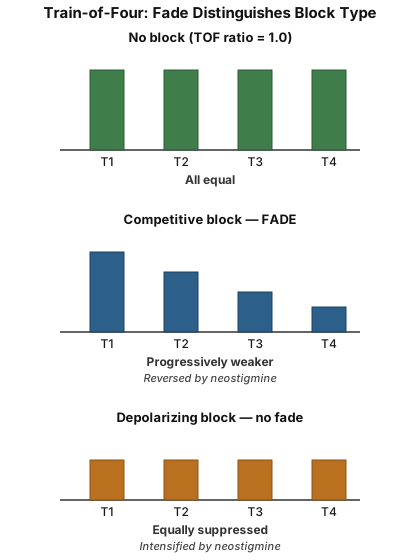
TOF monitoring: 4 supramaximal stimuli, ratio=T4/T1. Normal=1.0. Competitive block: ratio<1.0 (fade), improves with recovery, breathing resumes at ratio>0.7. Classical depolarizing: ratio≈1.0 (no fade) despite reduced absolute height.
Duration classes: Long (pancuronium, doxacurium, pipecuronium, 60-120min, renal elimination) · Intermediate (vecuronium, atracurium, cisatracurium, rocuronium, 20-50min, plasma/liver metabolism — MOST COMMONLY USED today) · Short (mivacurium, 15-30min) · Succinylcholine (fastest onset 1-1.5min, shortest duration 5-8min — standard for RAPID INTUBATION).
Histamine release: d-TC(most) > atracurium/mivacurium(significant) > newer steroidal agents(vecuronium/pancuronium/rocuronium, minimal). Ganglionic: d-TC(most, →hypotension) · pancuronium(vagal block+NA release→tachycardia/↑BP) · newer agents(negligible CV effects — practical advantage).
Reversal: Neostigmine+atropine (↑ACh outcompetes blocker) — anticholinesterase mechanism. Sugammadex — DIFFERENT mechanism, physically encapsulates rocuronium/vecuronium in inactive chelate, works regardless of block depth.
Uses: Surgical relaxation · Intubation (SCh, speed) · Ocular surgery (competitive blockers — spare larger muscles at doses paralyzing extraocular muscles) · ICU ventilation (vecuronium infusion) · ECT (SCh, prevents trauma) · Severe tetanus/status epilepticus unresponsive to diazepam (last resort + ventilation).
Directly acting: Dantrolene
Mechanism ENTIRELY different — no effect on NMJ/action potential. Binds RyR1 (ryanodine receptor Ca²⁺ channel) in skeletal muscle sarcoplasmic reticulum → blocks Ca²⁺-induced Ca²⁺ release → uncouples excitation from contraction. Cardiac/smooth muscle = RyR2 (different subtype) → largely spared.
Oral: spasticity in UMN disorders (hemiplegia, paraplegia, cerebral palsy, MS) — but ↓voluntary power too → limits use mostly to bedridden patients.
IV: DRUG OF CHOICE for malignant hyperthermia (fluorinated anaesthetics + SCh in genetically susceptible RyR1-abnormal patients → persistent SR Ca²⁺ release → sustained contraction + dangerous hyperthermia). Directly reverses the mechanism, not just symptoms.
Centrally acting relaxants
Selectively depress polysynaptic reflexes (spinal/supraspinal), spare monosynaptic stretch reflex → ↓tone WITHOUT abolishing voluntary movement. Ascending reticular formation also uses polysynaptic pathways → ALL have some sedation as unavoidable consequence.
| Central relaxants | NM blockers | |
|---|---|---|
| Voluntary power | Reduced tone, NOT abolished | Abolished entirely |
| CNS effect | Some sedation | None (quaternary, no BBB) |
| Route | Oral ± parenteral | Almost always IV |
| Use | Chronic spasticity, acute spasm, tetanus | Short-term surgical |
Mephenesin group (carisoprodol, chlorzoxazone, chlormezanone, methocarbamol): spinal internuncial neurone level. Efficacy NOT well established. GI irritation + sedation.
Diazepam: supraspinal, ↑GABAergic transmission (BZD receptor). No GI irritation. Valuable in spinal injury, tetanus.
Baclofen: GABA analogue, selective GABA-B agonist (metabotropic, G-protein coupled, ↑K+ conductance, bicuculline-INSENSITIVE) — mechanistically DISTINCT from BZDs (GABA-A, ionotropic Cl- channel, bicuculline-sensitive). Acts spinally, ↓excitatory transmitter release, depresses BOTH poly+monosynaptic reflexes → some weakness but LESS sedating than diazepam. Preferred for MS, ALS, spinal injury. Relatively INEFFECTIVE in stroke, cerebral palsy, ordinary traumatic/rheumatic spasm. Sudden withdrawal → hallucinations, tachycardia, seizures (taper, don’t stop abruptly).
Tizanidine: clonidine congener, central α2 agonist, ↓excitatory amino acid release in spinal interneurones (±facilitates glycine). ↓tone/spasm WITHOUT ↓muscle strength. Efficacy ~baclofen/diazepam, fewer side effects. Caution with antihypertensives (esp. clonidine).
Thiocolchicoside: colchicine-related, GABA-mimetic/glycinergic + analgesic. Combined with NSAIDs for painful spasm (torticollis, sprains, backache).
Uses: Acute spasm (mephenesin/BZD + analgesics) · Torticollis/lumbago/backache · Anxiety+↑tone (diazepam, chlormezanone) · UMN spasticity — baclofen, diazepam, tizanidine, dantrolene YES; mephenesin group NO (important distinction — not interchangeable) · Tetanus (diazepam infusion, or methocarbamol) · ECT (diazepam, ↓trauma).
Clinical relevance
“Muscle relaxant” = 3 unrelated mechanisms: NM blocker (receptor blockade at endplate), dantrolene (Ca²⁺-release blockade in muscle fibre), central relaxants (GABA-mediated spinal inhibition). Confusing them has real consequences — an NM blocker for spasticity abolishes movement entirely rather than reducing tone; dantrolene cannot reverse a competitive NM block since it doesn’t touch the receptor at all.
Overview
Skeletal muscle relaxants act at three distinct levels — the neuromuscular junction, the muscle fibre itself, or centrally within the spinal cord/brainstem — and this level of action is the organizing principle for the whole topic, because it directly determines what each class is actually used for. Neuromuscular blockers paralyze muscle completely and are used almost exclusively alongside general anaesthesia for surgery; centrally acting relaxants reduce muscle tone and painful spasm without abolishing voluntary movement, and are used for spastic and painful-spasm conditions instead.
Neuromuscular Blocking Agents
These act at the nicotinic (NM) receptor of the skeletal muscle endplate and fall into two mechanistically distinct groups.
Competitive (Non-Depolarizing) Block
Curare and its synthetic descendants (d-tubocurarine — historic, no longer used clinically — and the modern congeners) have affinity for the NM receptor but no intrinsic activity: they occupy the receptor without activating it, physically preventing ACh from triggering the conformational change needed to open the channel. Enough ACh released from the nerve ending fails to combine with a receptor that the endplate potential falls below the threshold needed to trigger a propagated muscle action potential, and the muscle fails to contract.
Because this is true competitive antagonism, it is surmountable: raising ACh concentration (either in vitro, or in vivo with an anticholinesterase) can overcome the block. This is the pharmacological basis for reversing non-depolarizing block with neostigmine.
Competitive blockers also occupy prejunctional nicotinic receptors on the motor nerve ending itself, which normally help mobilize additional ACh quanta during repetitive stimulation — blocking these contributes an extra layer of depression during sustained activity, producing the characteristic “fade” on repetitive/tetanic stimulation (progressively weaker responses), followed by post-tetanic potentiation (a transient stronger single twitch immediately after a tetanic burst, from increased prejunctional ACh mobilization).
Depolarizing Block
Succinylcholine (suxamethonium) and decamethonium have both affinity and submaximal intrinsic activity at the NM receptor — they open the Na+ channel just as ACh does, producing initial depolarization with visible muscle fasciculations and twitching. Because they are not hydrolyzed by AChE and dissociate from the receptor only slowly, the endplate remains persistently depolarized, inactivating the surrounding Na+ channels and creating a zone of inexcitability that ACh released from the nerve can no longer overcome — flaccid paralysis follows the initial twitching.
This produces the opposite behaviour from competitive block on every practically testable feature, which is exactly why the comparison table below is worth knowing cold rather than reasoning it out from first principles under exam pressure:
| Feature | Competitive block (d-TC type) | Depolarizing block (succinylcholine, Phase I) |
|---|---|---|
| Onset in man | Progressive weakness → flaccid paralysis | Fasciculations → flaccid paralysis |
| Tetanic stimulation | Poorly sustained (“fade”) | Well sustained (no fade) |
| Post-tetanic potentiation | Present | Absent |
| Effect of neostigmine | Antagonizes/reverses the block | Intensifies the block |
| Order of paralysis | Fingers/eyes → limbs → neck/face → trunk → respiratory | Neck/limbs → face/jaw/eyes/pharynx → trunk → respiratory |
Phase II block: with high-dose or continuous-infusion succinylcholine (or in patients with atypical/deficient plasma pseudocholinesterase), the block converts to a second phase that resembles competitive block — the membrane repolarizes but transmission is not restored, fade reappears, and the block becomes partially reversible by anticholinesterases. This conversion is clinically important because it changes how the block should be managed mid-procedure.
Genetic pseudocholinesterase deficiency is a high-yield pharmacogenetic fact in its own right: succinylcholine is normally hydrolyzed rapidly by plasma pseudocholinesterase (action lasting only 5–8 minutes). Homozygotes for the abnormal enzyme (roughly 1 in 3000) develop prolonged Phase II block with paralysis and apnoea lasting 4–6 hours, manageable only with mechanical ventilation until natural recovery; heterozygotes (roughly 1 in 50) show a milder 2–3 fold prolongation.
Monitoring Neuromuscular Block: Train-of-Four
Because a single twitch response is hard to interpret without a pre-block baseline, clinical practice uses the train-of-four (TOF) protocol: four supramaximal stimuli are applied 0.5 seconds apart, and the ratio of the 4th twitch’s strength to the 1st (the TOF ratio) is tracked.
An untreated subject shows a TOF ratio of 1.0 (all four twitches equal). During competitive block, the ratio falls below 1.0 — fade — because the degree of fade tracks the degree of block; as the block wears off, the ratio recovers toward 1.0, and spontaneous breathing can generally resume once it exceeds 0.7. Classical (Phase I) depolarizing block does not show fade — all four twitches are suppressed equally, and the TOF ratio stays near 1.0 even though absolute twitch height is reduced. Fade reappears if depolarizing block converts to Phase II, at which point it behaves like competitive block on this test too.
Comparative Properties and Individual Drugs
Non-depolarizing blockers are grouped by duration:
- Long-acting (d-tubocurarine — obsolete; pancuronium, doxacurium, pipecuronium) — 60–120 min duration, generally kidney-eliminated, reserved now for prolonged surgeries needing sustained relaxation.
- Intermediate-acting (vecuronium, atracurium, cisatracurium, rocuronium) — 20–50 min, metabolized in plasma/liver, the most frequently selected agents in modern practice for routine surgical relaxation.
- Short-acting (mivacurium) — 15–30 min.
- Succinylcholine (the only depolarizing blocker in routine use) — fastest onset (paralysis within 1–1.5 min) and shortest duration (5–8 min, hydrolyzed by plasma pseudocholinesterase) — the standard choice for rapid endotracheal intubation specifically because of this speed.
Histamine release (flushing, bronchospasm, hypotension, non-immune) is prominent with d-tubocurarine, significant with atracurium and mivacurium, and minimal with the newer steroidal agents (vecuronium, pancuronium, rocuronium). Ganglionic effects: d-tubocurarine has the most ganglion-blocking activity (contributing to its hypotension, alongside histamine release and reduced venous return from limb/respiratory muscle paralysis); pancuronium instead causes vagal blockade and noradrenaline release, tending toward tachycardia and a BP rise; the newer agents (vecuronium, rocuronium, cisatracurium) are largely free of cardiovascular effects — a genuine practical advantage that has driven their adoption over the older drugs.
Reversal: neostigmine (with atropine to block its muscarinic side effects) reverses competitive block by raising ACh concentration at the endplate enough to out-compete the blocker. Sugamadex is a newer, mechanistically distinct reversal agent specific to rocuronium (and vecuronium) — it physically encapsulates the steroidal blocker molecule in an inactive chelate, unrelated to anticholinesterase action, and reverses block within minutes regardless of the depth of block, which conventional anticholinesterase reversal cannot always achieve.
Uses of Neuromuscular Blockers
- Surgical muscle relaxation — lighter planes of general anaesthesia become possible, and reflex muscle contraction at the surgical site is reduced, most valuable in abdominal/thoracic surgery.
- Endotracheal intubation — succinylcholine’s speed makes it standard for brief procedures (intubation, laryngoscopy, bronchoscopy) and for treating laryngospasm.
- Ocular surgery — competitive blockers are preferred because extraocular muscles are paralyzed at doses that spare larger muscle groups.
- Assisted ventilation in ICU — sub-paralyzing infusion (typically vecuronium) reduces chest wall resistance to mechanical inflation; prolonged infusion carries its own risk of extended block from active metabolite accumulation.
- Electroconvulsive therapy — prevents convulsion-associated trauma/fractures without blunting the therapeutic seizure itself; succinylcholine is standard, mivacurium an alternative.
- Severe tetanus/status epilepticus unresponsive to diazepam — paralysis with a competitive blocker plus mechanical ventilation, as a last resort.
Directly Acting Muscle Relaxants
Dantrolene acts entirely differently from neuromuscular blockers — it does not touch neuromuscular transmission or the muscle action potential at all, instead uncoupling excitation from contraction directly at the muscle fibre. It binds the ryanodine receptor (RyR1) calcium channel of the skeletal muscle sarcoplasmic reticulum and prevents calcium-induced calcium release, interfering with the intracellular calcium surge that excitation-contraction coupling normally requires. Because cardiac and smooth muscle express a different ryanodine receptor subtype (RyR2), dantrolene has comparatively little effect on them — a clean selectivity that makes it safe to use despite its profound effect on skeletal muscle.
Given orally, dantrolene reduces spasticity in upper motor neurone disorders (hemiplegia, paraplegia, cerebral palsy, multiple sclerosis), though the accompanying loss of voluntary power limits its practical use largely to bedridden patients where that trade-off doesn’t matter as much. Given IV, it is the drug of choice for malignant hyperthermia — a life-threatening reaction to fluorinated inhalational anaesthetics (and succinylcholine) in genetically susceptible individuals with an abnormal RyR1, causing persistent sarcoplasmic calcium release, sustained muscle contraction, and dangerous hyperthermia; dantrolene directly reverses the mechanism causing it, not just the fever.
Centrally Acting Muscle Relaxants
These reduce muscle tone by selectively depressing polysynaptic spinal/supraspinal reflexes involved in tone regulation, while sparing the monosynaptic stretch reflex — the mechanistic basis for why they reduce spasm without abolishing voluntary movement, unlike neuromuscular blockers. Because the ascending reticular formation (which maintains wakefulness) also relies partly on polysynaptic pathways, all centrally acting relaxants carry some sedative property as an unavoidable consequence of the same mechanism.
| Centrally acting relaxants | Neuromuscular blockers | |
|---|---|---|
| Effect on voluntary power | Reduces tone without abolishing it | Abolishes voluntary movement entirely |
| Site | Selectively inhibits polysynaptic CNS reflexes | Blocks neuromuscular transmission |
| CNS effect | Some sedation | None (quaternary, doesn’t cross BBB) |
| Route | Oral, sometimes parenteral | Almost always IV |
| Typical use | Chronic spasticity, acute spasm, tetanus | Short-term surgical relaxation |
Mephenesin-group agents (mephenesin itself is now obsolete due to GI irritation and IV toxicity; carisoprodol, chlorzoxazone, chlormezanone, methocarbamol) act at the spinal internuncial neurone level; clinical efficacy for this whole group is not well established, and gastric irritation plus sedation are the dominant side effects.
Diazepam — the prototype benzodiazepine, acting supraspinally by enhancing GABAergic transmission at the BZD receptor; well tolerated (no gastric irritation), sedation-limited dosing, particularly valuable in spinal injury and tetanus.
Baclofen — a GABA analogue and selective GABA-B receptor agonist, mechanistically distinct from benzodiazepines (which act at GABA-A, an ionotropic Cl− channel blocked by bicuculline). GABA-B is instead a metabotropic, G-protein-coupled receptor that hyperpolarizes neurones via K+ conductance — insensitive to bicuculline. Baclofen acts primarily in the spinal cord, reducing excitatory transmitter release and depressing both polysynaptic and monosynaptic reflexes; it does produce some muscle weakness but is less sedating than diazepam. It is the preferred drug for spasticity in multiple sclerosis, ALS, and spinal injury, but relatively ineffective in stroke, cerebral palsy, and ordinary traumatic/rheumatic muscle spasm — a distinction worth holding onto, since it means baclofen is not a universal spasticity drug. Sudden withdrawal after chronic use can cause hallucinations, tachycardia, and seizures — another instance of the tapering principle seen elsewhere in this subject.
Tizanidine — a clonidine congener acting as a central α2 agonist, inhibiting release of excitatory amino acids in spinal interneurones (and possibly facilitating glycine); reduces tone and spasm frequency without reducing muscle strength, with efficacy comparable to baclofen/diazepam but generally fewer side effects; caution needed with concurrent antihypertensives, especially clonidine.
Thiocolchicoside — chemically related to colchicine, acting as a GABA-mimetic/glycinergic agent with additional analgesic action; commonly combined with NSAIDs for painful spasm (torticollis, sprains, backache).
Uses of Centrally Acting Muscle Relaxants
- Acute muscle spasm (sprains, ligament tears, fibrositis, bursitis) — mephenesin-group and benzodiazepine relaxants combined with analgesics, though efficacy is not strongly established.
- Torticollis, lumbago, backache, neuralgias — respond similarly to acute spasm.
- Anxiety/tension states with increased muscle tone — diazepam and chlormezanone benefit from their dual antianxiety and muscle-relaxant action.
- Upper motor neurone spasticity (multiple sclerosis, spinal injury, cerebral palsy) — baclofen, diazepam, tizanidine, and dantrolene are effective; the mephenesin group is not, a distinction worth remembering since these two categories of centrally acting relaxants are not interchangeable despite sharing the same broad classification.
- Tetanus — diazepam infusion (dose titrated by response) is most common; methocarbamol is an alternative.
- Electroconvulsive therapy — diazepam reduces convulsion-associated trauma.
Clinical Relevance
The single fact worth carrying out of this topic is that “muscle relaxant” is not one pharmacological category — a neuromuscular blocker, dantrolene, and baclofen relieve muscle activity through three completely unrelated mechanisms (receptor blockade at the endplate, calcium-release blockade in the muscle fibre, and GABA-B-mediated spinal inhibition respectively), and mixing them up has real consequences: giving a neuromuscular blocker for spasticity would abolish voluntary movement entirely rather than just reducing tone, and expecting dantrolene to reverse a competitive neuromuscular block would fail completely, since it doesn’t touch the receptor causing that block at all.
Diagram 1 — Train-of-Four (TOF): Fade Distinguishes Competitive from Depolarizing Block
What to draw: Three small bar-chart panels side by side, each showing four twitch-response bars (T1–T4) for: no block (all equal), competitive block (progressively shorter bars — fade), and classical depolarizing block (equally shortened bars — no fade).
Labelling requirements: each panel must state its TOF ratio explicitly (1.0, less than 1.0, approximately 1.0) — the ratio, not just the visual pattern, is what’s actually measured and reported clinically. Label which panel is reversed and which is intensified by neostigmine directly under the relevant panel; this opposite-direction response is the single most exam-tested consequence of the mechanism difference.
Common exam-marking mistakes:
- Describing depolarizing block as having “no twitch response” rather than equally-suppressed-but-present twitches — the TOF pattern specifically distinguishes reduced-but-equal (depolarizing) from progressively-fading (competitive), not present-vs-absent.
- Forgetting that fade reappears if depolarizing block converts to Phase II — a student who only memorizes “depolarizing block never fades” will get this specific conversion scenario wrong.
Diagram 2 — Dantrolene’s Site of Action at the Sarcoplasmic Reticulum
What to draw: A skeletal muscle fibre cross-section showing the sarcoplasmic reticulum with its ryanodine receptor (RyR1) calcium channel, with an arrow showing calcium release into the sarcoplasm during normal excitation-contraction coupling, and dantrolene shown blocking that specific channel.
Labelling requirements: label the channel specifically as RyR1, and note alongside it that cardiac/smooth muscle use the different RyR2 subtype — this is the entire reason dantrolene is selective for skeletal muscle and safe to use systemically. A diagram that shows “calcium channel blocked” without naming the subtype loses the mechanistic point entirely.
Common exam-marking mistakes:
- Drawing dantrolene’s action at the neuromuscular junction or motor endplate — it acts entirely within the muscle fibre itself, downstream of and unrelated to neuromuscular transmission; placing it at the synapse is a common conflation with neuromuscular blockers.
- Omitting that dantrolene does not affect the muscle action potential — only the intracellular calcium-release step that couples that action potential to actual contraction.
Short Essays (1)
Essays (2)
Short Notes (1)
Short Answers (19)
My Sticky Notes
Personal revision notes, mnemonics and reminders.
