
Lipoxins
Definition
Lipid mediators from arachidonic acid that counterbalance/regulate leukotriene action — a “stop signal” for acute inflammation. Same lipoxygenase pathway that makes leukotrienes also makes lipoxins.
Biosynthesis — transcellular (two cell types needed)
- Neutrophils generate LTA4 (lipoxygenase pathway intermediate)
- Platelets take up neutrophil-derived LTA4
- Platelet 12-lipoxygenase converts it → LXA4 + LXB4
Requires neutrophil-platelet contact — favoured at sites of thrombus formation / leukocyte-platelet interaction.
Actions (anti-inflammatory)
- Inhibit neutrophil chemotaxis
- Inhibit leukocyte adhesion to endothelium
Clinical relevance
Resolution of inflammation is active, not passive — same AA pathway ignites and extinguishes inflammation. Platelet dysfunction/drugs affecting platelets could also affect lipoxin generation (platelet-dependent step). Lipoxygenase pathway = both accelerator (leukotrienes) and brake (lipoxins), not purely pro-inflammatory.
Definition
Lipoxins are lipid mediators derived from arachidonic acid that act to regulate and counterbalance the pro-inflammatory actions of leukotrienes, making them one of the principal “stop signals” that help bring an acute inflammatory response to a close. They arise from the lipoxygenase arm of arachidonic acid metabolism, the same pathway that produces the pro-inflammatory leukotrienes, which is what allows lipoxins to act as a built-in counterweight to a process generated from the identical starting material.
Source and Biosynthesis
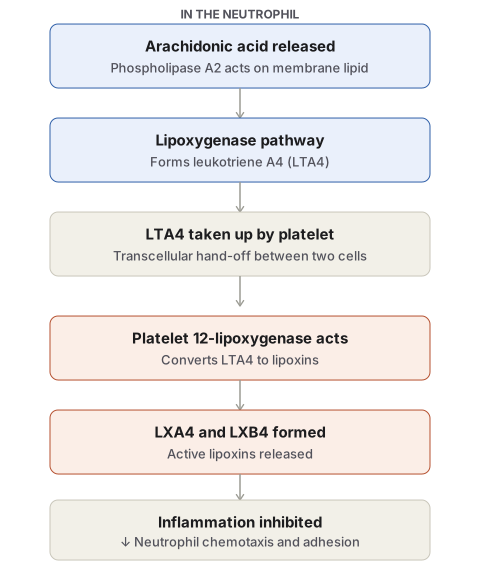
Arachidonic acid is released from membrane phospholipids by phospholipase A2 and metabolised along two enzymatic routes: the cyclo-oxygenase pathway, which yields prostaglandins and thromboxane, and the lipoxygenase pathway, which yields both leukotrienes and lipoxins.
Lipoxin formation is distinctive in requiring the cooperation of two different cell types, a process called transcellular biosynthesis.
- Neutrophils generate leukotriene A4 (LTA4) as an intermediate of the lipoxygenase pathway.
- This LTA4 is taken up by platelets, which express the enzyme 12-lipoxygenase (also called lipoxygenase-12).
- Platelet 12-lipoxygenase converts the neutrophil-derived LTA4 into lipoxin A4 (LXA4) and lipoxin B4 (LXB4).
Because their formation depends on an intermediate handed off from one cell type to another, lipoxins are generated preferentially at sites where neutrophils and platelets are in close contact, such as within a forming thrombus or at sites of leukocyte-platelet interaction during inflammation.
Actions
Unlike the other arachidonic acid metabolites, which promote inflammation, lipoxins act specifically to inhibit it.
- Inhibit neutrophil chemotaxis, reducing further recruitment of neutrophils to the site.
- Inhibit adhesion of leukocytes to endothelium, limiting the entry of additional inflammatory cells into the tissue.
Clinical Relevance
- Lipoxins illustrate that resolution of inflammation is an active, mediator-driven process rather than the passive fading of a stimulus — the same arachidonic acid pathway that ignites acute inflammation also produces the signal that helps extinguish it.
- Because lipoxin generation depends on platelet-neutrophil interaction, disorders or drugs that alter platelet function have the potential to affect not only clot formation but also this counter-regulatory arm of the inflammatory response, a connection worth keeping in mind when interpreting prolonged or poorly resolving inflammation.
- Recognising lipoxins alongside leukotrienes reframes the lipoxygenase pathway as a source of both an accelerator and a brake on inflammation, rather than a purely pro-inflammatory route, which is the more complete way this pathway should be understood.
Diagram 1: Transcellular Biosynthesis of Lipoxins
Draw two cells side by side in close contact — a neutrophil on the left, a platelet on the right — with the biosynthetic steps shown passing from one into the other.
Neutrophil (left): show arachidonic acid being released from the membrane, then converted along the lipoxygenase pathway into leukotriene A4 (LTA4), drawn as a small molecule diffusing toward the neutrophil’s edge closest to the platelet.
Transfer: draw a short arrow crossing the gap between the two cells, carrying the LTA4 molecule from the neutrophil into the platelet — label this arrow “transcellular transfer.”
Platelet (right): show the transferred LTA4 encountering the enzyme 12-lipoxygenase inside the platelet, and being converted into two labelled products, LXA4 and LXB4, which are then released from the platelet.
Labels required
- Both cell types must be individually labelled (neutrophil, platelet), since the defining feature of this pathway is that it requires two different cells, not one.
- The transfer arrow must be explicitly labelled “transcellular,” the specific term examiners look for.
- 12-lipoxygenase must be named as the platelet-specific enzyme responsible for the final conversion step.
Errors commonly made
- Drawing lipoxin synthesis as occurring entirely within a single cell — the two-cell, transcellular nature of the pathway is the single most important and most frequently missed feature of this topic.
- Failing to name 12-lipoxygenase specifically, describing the platelet step only as “further metabolism.”
Diagram 2: Lipoxygenase Pathway — One Route, Two Opposite Outcomes
Draw a single starting point, “Lipoxygenase pathway,” branching into two arrows with opposite-coloured endpoints.
- One branch leads to a box labelled “Leukotrienes” with a downward-pointing arrow beside it marked “pro-inflammatory — vasoconstriction, bronchospasm, ↑ permeability.”
- The other branch leads to a box labelled “Lipoxins” with an upward-pointing arrow beside it marked “anti-inflammatory — ↓ chemotaxis, ↓ adhesion.”
Labels required
- Both branches must originate visibly from the same starting point, since the shared origin of these opposite-acting mediators is the specific point being tested.
- The directional arrows (down for pro-inflammatory, up for anti-inflammatory, or any similarly clear opposite-facing convention) should make the contrast immediately visible, not just stated in words.
Errors commonly made
- Presenting lipoxins as though they arise from a separate pathway from leukotrienes, rather than the same lipoxygenase route branching to different endpoints.
Multiple Choice Questions (1)
My Sticky Notes
Personal revision notes, mnemonics and reminders.
