
Paroxysmal Nocturnal Haemoglobinuria
Overview
PNH = rare ACQUIRED red cell membrane disorder, adult life, chronic intravascular haemolysis from complement over-sensitivity. Unlike inherited haemolytic anaemias — arises from somatic mutation in a haematopoietic STEM CELL, so affects RBCs+WBCs+platelets (mutant clone alongside residual normal clone).
Pathogenesis
Mutation in PIGA (X-linked gene, needed for GPI-anchor synthesis). X-linked = only one active copy per cell → single mutation hit is enough (unlike most acquired mutations needing both alleles hit).
Loss of GPI anchor → ~20 GPI-anchored proteins deficient. Two matter most for RBC survival:
- DAF (CD55)
- MIRL (CD59)
Both normally restrain complement. Without them → RBCs very sensitive to complement C5b-C9 membrane attack complex (MAC). WBCs/platelets share defect but less complement-sensitive → RBCs bear the brunt.
“Nocturnal” pattern: sleep → CO2 retention → mild ↓blood pH → enhanced complement fixation → overnight haemolysis bursts → brown morning urine. BUT most patients actually present with chronic anaemia+iron deficiency, not classic nocturnal paroxysms.
Stem cell disorder → linked to aplastic anaemia (may precede/follow), ~20% progress to myeloproliferative/myelodysplastic disorder, some to AML.
Clinical/lab findings
Haemolytic anaemia + pancytopenia (mild granulocytopenia/thrombocytopenia common — shared stem cell origin). Intermittent haemoglobinuria (classically nocturnal, brown morning urine). Haemosiderinuria very common. Venous thrombosis — common complication. Ham’s test + sucrose haemolysis test demonstrate complement sensitivity.
Complications
Most feared: THROMBOSIS, often unusual sites — abdominal veins (portal, hepatic → Budd-Chiari). Linked to same excess complement activity as haemolysis.
Treatment
Eculizumab — binds C5, blocks C5b-C9 MAC assembly. ↓Intravascular haemolysis + ↓thrombosis. No effect on early complement steps → some extravascular haemolysis persists (C3b-mediated). Blocks host defence vs encapsulated organisms → ↑Neisseria infection risk (esp. meningococcal sepsis) → MUST vaccinate against N. meningococcus before starting.
Clinical relevance
PNH is an exception to “acquired mutations need both alleles hit” — PIGA is X-linked, only one active copy per cell, so single hit suffices. Explains why this rare clonal disorder arises from otherwise common DNA damage. Nocturnal pattern = physiological curiosity (sleep pH shift), not the disease’s core feature — most patients present with chronic anaemia, not textbook paroxysms. PNH+Budd-Chiari/unusual abdominal vein thrombosis+haemolytic anaemia = classic association, high-yield. Eculizumab mechanism (blocks only terminal complement, C5 onward) explains why extravascular haemolysis persists while intravascular haemolysis+thrombosis improve — and directly explains mandatory meningococcal vaccination.
Overview
Paroxysmal nocturnal haemoglobinuria (PNH) is a rare acquired disorder of the red cell membrane, presenting generally in adult life, producing chronic intravascular haemolysis from undue red cell sensitivity to complement. Unlike the inherited haemolytic anaemias covered elsewhere in this section, PNH arises from a somatic mutation in a haematopoietic stem cell — so the defect affects not just red cells but the entire myeloid progenitor lineage (RBCs, WBCs, platelets), and the mutant clone proliferates alongside the residual normal clone.
Pathogenesis
The mutation occurs in PIGA, an X-linked gene required for biosynthesis of glycosyl phosphatidylinositol (GPI), the anchor structure that tethers many proteins to the cell membrane. Because PIGA is X-linked, normal cells have only one active copy — a single mutational hit is sufficient to cause PIGA deficiency in the affected clone (unlike most acquired somatic mutations, which typically need to affect both alleles of an autosomal gene).
Loss of GPI-anchor synthesis produces partial or complete deficiency of roughly 20 different GPI-anchored membrane proteins. Two are of particular consequence for red cell survival:
- Decay-accelerating factor (DAF, CD55)
- Membrane inhibitor of reactive lysis (MIRL, CD59)
Both normally restrain complement activity at the cell surface. Their absence leaves PIGA-deficient red cells inordinately sensitive to lysis by the complement C5b–C9 membrane attack complex (MAC). Leukocytes and platelets share the same GPI-anchor deficiency, but are comparatively less complement-sensitive than red cells, so red cells bear the brunt of the attack.
The nocturnal pattern that gives the disease its name reflects a physiological detail rather than anything intrinsic to the defect: during sleep, CO₂ retention causes a modest fall in blood pH, which enhances complement fixation — producing bursts of haemolysis overnight, with brown urine (haemoglobinuria) noticed on waking. In practice, though, most patients present less dramatically, with chronic anaemia and iron deficiency from ongoing intravascular haemolysis, rather than the classic nocturnal paroxysms.
Because PNH is fundamentally a stem cell disorder, it is often linked with other clonal/stem cell disorders — it may precede, accompany, or follow aplastic anaemia, and roughly 20% of cases go on to develop a myeloproliferative or myelodysplastic disorder, with some progressing to acute myeloid leukaemia.
Clinical and Laboratory Findings
- Haemolytic anaemia with pancytopenia (mild granulocytopenia and thrombocytopenia are frequent, reflecting the shared stem cell origin of the defect).
- Intermittent haemoglobinuria — classically nocturnal, identified by brown morning urine, though many patients have a more chronic, less dramatic course.
- Haemosiderinuria — very common, reflecting chronic intravascular haemolysis (filtered haemoglobin is reabsorbed by renal tubular cells and stored as haemosiderin, later shed in urine).
- Venous thrombosis — a common and important complication (see Clinical Relevance below).
- Ham’s test (acid-induced haemolysis test) and the sucrose haemolysis test demonstrate the red cells’ abnormal complement sensitivity in vitro.
Complications
The most feared complication is thrombosis, often affecting unusual sites such as the abdominal veins (portal vein, hepatic vein — the latter producing Budd-Chiari syndrome). The prothrombotic tendency is linked to the same excessive complement activity driving haemolysis, rather than being a separate process.
Treatment
Eculizumab, a therapeutic antibody that binds complement component C5 and blocks assembly of the C5b–C9 membrane attack complex, substantially reduces both intravascular haemolysis and the incidence of thrombosis. It has no effect on the earlier steps of complement fixation, so treated patients continue to show some degree of extravascular haemolysis from C3b deposition on red cell surfaces. Because blocking terminal complement activity impairs a key host defence against encapsulated organisms, patients on eculizumab carry an increased risk of Neisseria infections, particularly meningococcal sepsis — all patients must be vaccinated against N. meningococcus before starting treatment.
Clinical Relevance
- PNH is a genuinely instructive exception to the rule that acquired somatic mutations usually need to hit both alleles of a gene to cause a loss-of-function phenotype — because PIGA is X-linked and only one copy is active in any given cell (male or female, by X-inactivation), a single mutational event is sufficient, explaining why a rare acquired clonal disorder can arise from what is otherwise a fairly common category of DNA damage.
- The nocturnal pattern is a physiological curiosity (sleep-related CO₂ retention → mild acidosis → enhanced complement fixation) rather than a fundamental feature of the disease — most patients actually present with chronic anaemia, not textbook nocturnal paroxysms, which is worth remembering so the name doesn’t mislead the clinical picture expected at diagnosis.
- The link between PNH and thrombosis at unusual sites (hepatic and portal veins) is a high-yield association — any patient presenting with Budd-Chiari syndrome or unexplained abdominal vein thrombosis, especially with a background of haemolytic anaemia, should prompt consideration of PNH.
- Eculizumab’s mechanism (blocking only the terminal complement pathway, C5 onward) explaining why treated patients still have some extravascular haemolysis (C3b-mediated) while their intravascular haemolysis and thrombosis risk improve dramatically, is a clean example of how understanding a drug’s exact target predicts which parts of a disease process it will and won’t fix — and directly explains the mandatory meningococcal vaccination requirement before treatment.
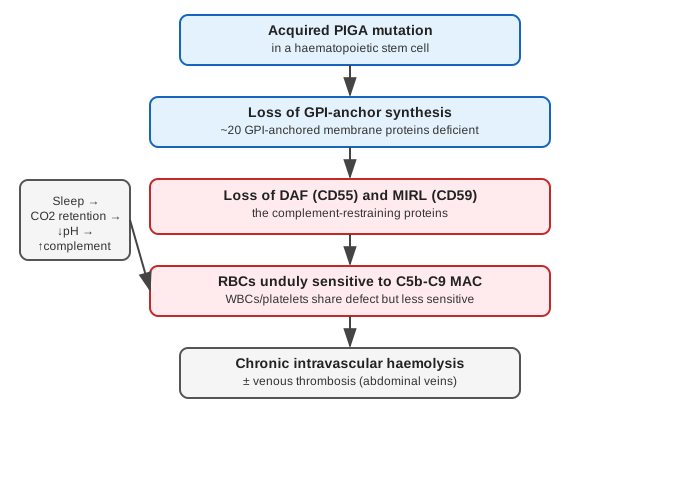
Diagram 1: Complement-Mediated Haemolysis Mechanism
Draw a single vertical chain of four boxes, with a small side-branch feeding into the third arrow to represent the nocturnal trigger.
- Acquired PIGA mutation — in a haematopoietic stem cell.
- Loss of GPI-anchor synthesis — ~20 GPI-anchored proteins deficient.
- Loss of DAF (CD55) and MIRL (CD59) — the complement-restraining proteins.
- RBCs unduly sensitive to C5b-C9 MAC — WBCs/platelets share the defect but are less sensitive.
- Chronic intravascular haemolysis ± venous thrombosis (abdominal veins).
Side branch (feeding into step 4→5, or noted alongside): sleep → CO₂ retention → ↓pH → enhanced complement fixation → explains the nocturnal clustering of haemolytic bursts.
Labels required
- DAF/CD55 and MIRL/CD59 must be named specifically, not left as “complement regulatory proteins” generically — these are the two the sources single out as directly responsible for red cell vulnerability.
- The nocturnal-trigger side branch must be visually separated from the main disease chain, since it explains only the timing of haemolytic bursts, not the underlying disease mechanism itself.
Errors commonly made
- Treating PNH as an inherited disorder because it involves a specific named gene (PIGA) — it is an acquired somatic mutation in a stem cell, not a germline/inherited defect.
- Assuming all three cell lines (RBC, WBC, platelet) are equally affected clinically — all three carry the GPI-anchor defect, but red cells are disproportionately more complement-sensitive, which is why the clinical picture is dominated by haemolysis rather than by leukocyte or platelet dysfunction.
My Sticky Notes
Personal revision notes, mnemonics and reminders.
