
Metaplasia
Definition
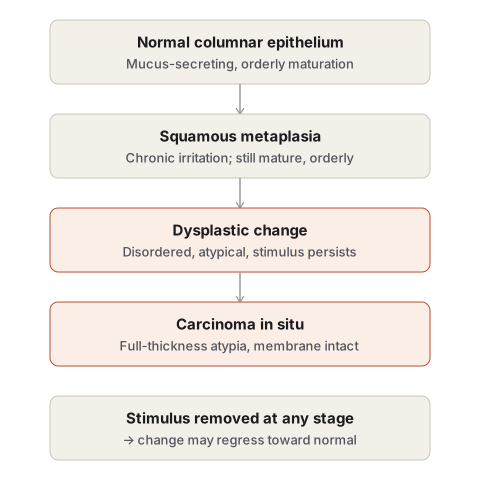
Reversible replacement of one adult epithelial or mesenchymal cell type by another, in response to a persistent abnormal stimulus. Reverts on withdrawal of stimulus; if the stimulus persists, may progress through dysplasia to malignancy.
Epithelial metaplasia — squamous (more common)
Chronic irritation converts specialised epithelium to squamous type:
- Bronchus (smokers)
- Endocervix (prolapse, old age)
- Gallbladder (chronic cholecystitis with stones)
- Prostatic ducts (chronic prostatitis, oestrogen therapy)
- Renal pelvis/bladder (chronic infection, stones)
- Nose, bronchi, urinary tract, lacrimal/salivary glands (vitamin A deficiency)
Epithelial metaplasia — columnar
- Intestinal metaplasia in healed chronic gastric ulcer
- Barrett oesophagus (see below)
- Chronic bronchitis/bronchiectasis (ciliated columnar → columnar)
- Cervical erosion (endocervical mucosa everted onto vagina)
Barrett oesophagus
Squamous → intestinal-type columnar epithelium of distal oesophagus, from chronic GORD (acid/bile reflux). Adaptive (more acid-resistant), but carries genuine risk of dysplasia → oesophageal adenocarcinoma. Managed as premalignant — endoscopic surveillance, not just an incidental finding.
Mesenchymal metaplasia
- Osseous: arterial wall (Mönckeberg’s, old age), soft tissue (myositis ossificans), laryngeal/bronchial cartilage (elderly), old chronic-inflammation scars, tumour stroma (leiomyoma).
- Cartilaginous: fracture healing at sites of excess mobility.
Metaplasia vs dysplasia
| Metaplasia | Dysplasia | |
|---|---|---|
| What changes | One adult cell type → another adult type | Disordered development of the same cell type |
| Types | Epithelial + mesenchymal | Epithelial only |
| Cells | Mature, just different | Pleomorphic, hyperchromatic, abnormal mitoses, lost polarity |
| Course | Reversible | May regress, or progress to CIS |
Clinical relevance
Identify and remove the chronic irritant — that’s the only reliable reversal. Barrett oesophagus is the standard proof that metaplasia isn’t automatically benign. Squamous metaplasia trades mucus protection for toughness — more infection-prone even while better resisting the original insult.
Definition
Metaplasia is a reversible change in which one type of adult epithelial or mesenchymal cell is replaced by another type of adult epithelial or mesenchymal cell, usually as an adaptive response to a persistent abnormal stimulus. The new cell type is typically better suited to withstand the stimulus than the original one, which is what makes the change adaptive rather than simply destructive. Metaplasia generally reverts to normal once the inciting stimulus is removed, but if the stimulus persists for a long period, the metaplastic epithelium can progress further, first to dysplasia and eventually to malignancy.
Metaplasia is broadly divided into two categories, epithelial and mesenchymal, of which epithelial metaplasia is far more common.
Epithelial Metaplasia
The metaplastic change may be patchy or diffuse, and it usually results in replacement by a tougher but less specialised epithelium. This trade-off has a cost: the replacing epithelium, being less specialised, often lacks the original tissue’s protective mucus secretion, leaving it more vulnerable to infection. Epithelial metaplasia takes one of two directions depending on the epithelium involved — squamous or columnar.
Squamous Metaplasia
The more common pattern, in which a variety of specialised epithelia convert to squamous epithelium in response to chronic irritation — mechanical, chemical, or infective.
- The bronchus, normally lined by pseudostratified ciliated columnar epithelium, in chronic smokers.
- The uterine endocervix, normally lined by simple columnar epithelium, in uterine prolapse and in old age.
- The gallbladder, normally lined by simple columnar epithelium, in chronic cholecystitis with gallstones.
- The prostatic ducts, normally lined by simple columnar epithelium, in chronic prostatitis and with oestrogen therapy.
- The renal pelvis and urinary bladder, normally lined by transitional epithelium, in chronic infection and with stones.
- The nose, bronchi, urinary tract, and lacrimal and salivary glands in vitamin A deficiency, alongside the more familiar xerophthalmia of the eye.
Columnar Metaplasia
Less common, but clinically important, transformation to columnar epithelium.
- Intestinal metaplasia in a healed chronic gastric ulcer.
- Columnar metaplasia of the oesophagus — Barrett oesophagus — discussed in detail below.
- Conversion of the pseudostratified ciliated columnar epithelium of chronic bronchitis and bronchiectasis to a columnar type.
- Cervical erosion, whether congenital or acquired, in which endocervical glandular mucosa is everted onto the vaginal portion of the cervix.
Barrett Oesophagus
Barrett oesophagus is the replacement of the normal squamous epithelium of the distal oesophagus by columnar epithelium of intestinal type, occurring as an adaptive response to chronic gastro-oesophageal reflux. Long-standing exposure of the squamous mucosa to refluxed acid and bile favours a more acid-resistant columnar lining, making this the textbook example of an adaptive, protective metaplasia.
Its clinical importance rests on its capacity to progress. Unlike most metaplastic epithelium, the intestinal-type columnar mucosa of Barrett oesophagus carries a genuine risk of progressing through dysplasia to oesophageal adenocarcinoma, and for this reason it is managed as a premalignant condition requiring endoscopic surveillance rather than as an incidental adaptive finding.
Mesenchymal Metaplasia
A less common form in which one adult mesenchymal tissue transforms into another.
- Osseous metaplasia — formation of bone within fibrous tissue, cartilage, or myxoid tissue — occurs in the arterial wall in old age (Mönckeberg medial calcific sclerosis), in soft tissue in myositis ossificans, in the cartilage of the larynx and bronchi in the elderly, in scars of long-standing chronic inflammation, and in the fibrous stroma of certain tumours such as leiomyoma.
- Cartilaginous metaplasia occurs during fracture healing at sites of excessive mobility.
Metaplasia Compared with Dysplasia
Because both are adaptive-seeming changes that occur in response to chronic stimuli, and because one can evolve into the other, distinguishing metaplasia from dysplasia is a frequent point of confusion.
| Feature | Metaplasia | Dysplasia |
|---|---|---|
| Definition | Change of one adult cell type to another adult cell type | Disordered cellular development |
| Types | Epithelial (squamous, columnar) and mesenchymal (osseous, cartilaginous) | Epithelial only |
| Typical tissues | Bronchial mucosa, uterine endocervix; mesenchymal tissues such as cartilage and arteries | Uterine cervix, bronchial mucosa |
| Cellular change | Mature cell development, simply of a different type | Disordered development — pleomorphism, nuclear hyperchromatism, abnormal mitoses, loss of polarity |
| Natural history | Reversible on withdrawal of the stimulus | May regress on withdrawal of the stimulus, or may progress to higher-grade dysplasia or carcinoma in situ |
Clinical Relevance
- Recognising metaplasia at a given site should prompt identification of the chronic irritant driving it, since removing that stimulus is the only reliable way to reverse the change and prevent progression.
- Barrett oesophagus is the clearest example of why metaplasia cannot be dismissed as a purely benign adaptation — its columnar epithelium is under active surveillance precisely because of its documented potential to progress to adenocarcinoma.
- Squamous metaplasia at any site trades protective mucus secretion for structural toughness, so metaplastic epithelium is paradoxically more vulnerable to superimposed infection even as it better withstands the original mechanical or chemical insult.
Diagram 1: Barrett Oesophagus (before and after)
Draw a longitudinal section through the lower oesophagus and gastro-oesophageal junction, shown as two stacked panels — normal above, Barrett oesophagus below.
Normal panel: the oesophageal lining drawn as a uniform layer of stratified squamous epithelium down to the gastro-oesophageal junction, where it meets the columnar gastric mucosa in a sharp, regular line (the Z-line).
Barrett panel: the same region, but with a tongue-shaped or circumferential segment of the distal squamous lining replaced by columnar epithelium of intestinal type, extending a short distance up from the junction; draw the new lining with small goblet cells scattered through it to indicate intestinal-type differentiation.
Labels required
- Label the replaced segment explicitly as “columnar epithelium, intestinal type” and name the goblet cells, since intestinal differentiation is the specific diagnostic feature examiners look for, not columnar change in general.
- Label the driving stimulus as “chronic gastro-oesophageal reflux (acid and bile).”
- Add a small arrow or note indicating the progression sequence: Barrett epithelium → dysplasia → adenocarcinoma, to tie the diagram to its clinical significance.
Errors commonly made
- Drawing plain columnar epithelium without goblet cells, which misses the intestinal-type detail that defines Barrett oesophagus specifically.
- Omitting the progression note — students often draw the metaplastic change correctly but fail to connect it to why the condition is under surveillance.
Diagram 2: Sequence from Normal Epithelium to Dysplasia
Draw a horizontal strip of four small panels, each showing a cross-section of the same epithelial surface (the uterine cervix is the conventional example) progressing left to right.
- Normal mucus-secreting columnar epithelium, uniform cell height, basally placed nuclei.
- Squamous metaplasia — the columnar layer replaced by an orderly, mature stratified squamous epithelium.
- Dysplastic change — increased numbers of epithelial layers, disordered arrangement of cells from base to surface, and nuclei no longer confined to the base (loss of polarity).
- Carcinoma in situ — full-thickness disorder and marked nuclear atypia, still confined above an intact basement membrane.
Labels required
- Each panel individually titled with its stage.
- Panel 3 must show at least three of the recognised dysplastic features individually: loss of polarity, increased layers, and pleomorphism — not a single generic “abnormal cells” label.
- Panel 4 must show the basement membrane intact and explicitly labelled, since “in situ” specifically means confinement above this layer.
Errors commonly made
- Skipping the metaplasia stage and drawing dysplasia as arising directly from normal epithelium — the sequence normal → metaplasia → dysplasia → carcinoma in situ is itself the examinable point.
- Breaching the basement membrane in the carcinoma in situ panel, which would make it invasive carcinoma rather than in situ disease.
My Sticky Notes
Personal revision notes, mnemonics and reminders.
