
Lead Poisoning
Overview
Heavy metal, binds sulfhydryl groups, interferes with Ca metabolism → haematologic+skeletal+neurologic+GI+renal toxicity.
Sources
Children (domestic): chewing lead furniture/toys/pencils, eating lead paint flakes. Adults (occupational/environmental): spray painting, battery recycling (PbO fumes), foundry work, mining/extraction | contaminated water (old lead pipes + water chemistry change → community outbreaks e.g. Flint MI), fresh lead paint, leaded petrol sniffing (→ unleaded petrol introduced).
Children absorb >50% ingested lead vs 15% adults + more permeable BBB → disproportionate paediatric susceptibility.
Absorption/distribution
GIT or lung absorption → 2 compartments:
- Bone/teeth/nails/hair (80-90%, “harmless” pool) — binds phosphate, competes with Ca; t½ 20-30yr; released back with ↑bone turnover (pregnancy, hyperthyroidism, osteoporosis)
- Blood+soft tissue (brain/liver/kidney/marrow, 5-10%) — directly toxic fraction, renal excretion
Haematologic mechanism
Lead blocks 2 haem-synthesis enzymes (sulfhydryl affinity):
- ALA dehydratase — blocks ALA→porphobilinogen
- Ferrochelatase — blocks Fe²⁺ insertion into protoporphyrin IX → zinc protoporphyrin (ZPP) forms instead of haem → ↓Fe incorporation → microcytic hypochromic anaemia + basophilic stippling Separate mechanism: inhibits RBC Na⁺/K⁺-ATPase → ↑fragility → haemolysis
Dx: ↑blood lead / ↑free erythrocyte protoporphyrin / ↑ZPP. Mild cases: anaemia = only finding. Suspect when unexplained anaemia + basophilic stippling.
Organ toxicity
Nervous system (age-dependent pattern):
- Children: CENTRAL — lead encephalopathy (brain oedema, flattened gyri, compressed ventricles); ↓IQ/learning disability/psychomotor delay→blindness/psychosis/seizures/coma; irreversible
- Adults: PERIPHERAL — demyelinating motor neuropathy, radial+peroneal nerves → wristdrop+footdrop; reversible with exposure removal
Kidney — proximal tubular toxicity, intranuclear lead-protein inclusion bodies, chronic tubulointerstitial disease
GI — lead colic (severe poorly-localised abdominal pain, mimics acute abdomen, mechanism unclear)
Skeletal — interferes with growth plate remodelling in children → radiodense “lead lines” at metaphysis; delays fracture healing (↑chondrogenesis, delayed cartilage mineralisation); Burton line = linear gum hyperpigmentation
Clinical relevance
Child=central/irreversible/domestic-source vs Adult=peripheral/reversible/occupational-source — single most tested contrast. Unexplained microcytic anaemia+basophilic stippling = classic lead vignette (≠ iron deficiency/thalassaemia which lack prominent stippling). Bone reservoir (20-30yr t½) → pregnancy/hyperthyroidism/osteoporosis can resurface old lead toxicity. Lead colic + Burton line/lead lines = cheap bedside/radiographic clues to an easily-missed diagnosis.
Overview
Lead is a readily absorbed heavy metal that binds sulfhydryl groups in proteins and interferes with calcium metabolism, producing toxicity across haematologic, skeletal, neurologic, gastrointestinal, and renal systems. Exposure may be accidental or occupational, and children and adults differ markedly both in their sources of exposure and in the pattern of resulting disease.
Sources of Exposure
In children, exposure is chiefly domestic:
- Chewing lead-containing furniture, toys, or pencils.
- Eating flakes of lead-based paint from walls (a particular hazard in older housing).
In adults, exposure is chiefly occupational and environmental:
- Occupational — spray painting, recycling of automobile batteries (lead oxide fumes), foundry work, mining and extraction of lead.
- Environmental/accidental — contaminated water supply (ageing lead pipes can leach lead into tap water when water chemistry changes — a documented cause of community-wide lead poisoning outbreaks), freshly lead-painted housing, and historically, sniffing of leaded petrol (the reason unleaded petrol was introduced).
Lead exposure disproportionately affects children for two compounding reasons: children absorb over 50% of ingested lead, versus only about 15% in adults, and a more permeable blood-brain barrier in childhood increases susceptibility to CNS damage.
Absorption and Distribution
Lead is absorbed through the gastrointestinal tract or the lungs and distributes into two compartments:
- Bone, teeth, nails, and hair — the relatively inert storage pool, taking up roughly 80–90% of absorbed lead. Lead binds phosphate in bone, competitively reducing calcium binding; once incorporated, it is stable with a half-life of 20–30 years, but can be released back into the bloodstream whenever bone turnover accelerates (pregnancy, hyperthyroidism, osteoporosis).
- Blood and soft tissues (brain, liver, kidneys, bone marrow) — the remaining 5–10% (blood) plus soft-tissue distribution, which is the directly toxic, metabolically active fraction; this fraction is excreted via the kidneys.
Mechanism of Haematologic Toxicity
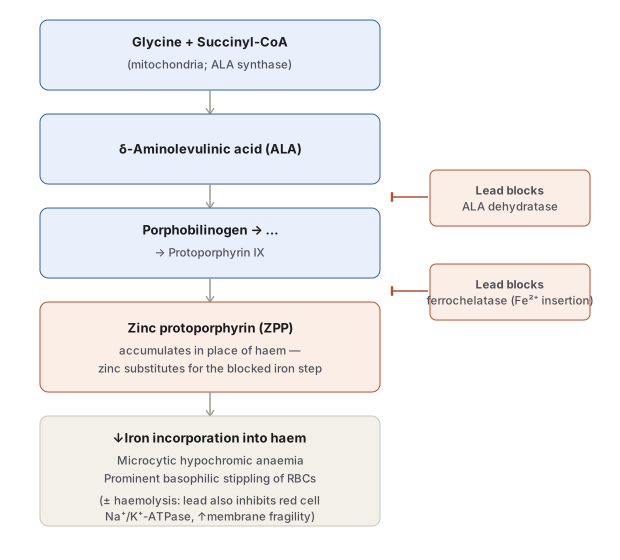
Lead’s high affinity for sulfhydryl groups lets it block two enzymes of the haem synthesis pathway: δ-aminolevulinic acid dehydratase (ALA dehydratase), blocking conversion of ALA to porphobilinogen, and ferrochelatase, the enzyme that normally inserts ferrous iron into protoporphyrin IX to complete haem synthesis. With ferrochelatase blocked, zinc is incorporated instead, forming zinc protoporphyrin (ZPP), which accumulates in place of haem. The net effect is decreased iron incorporation, producing a microcytic hypochromic anaemia with characteristic, prominent basophilic stippling of erythrocytes. Separately, lead inhibits red cell membrane Na⁺/K⁺-ATPase, increasing membrane fragility and contributing additional haemolysis.
Elevated blood lead, red cell free protoporphyrin, or zinc-protoporphyrin levels are required for a definitive diagnosis — in milder exposure, anaemia may be the only obvious finding, and lead poisoning should be suspected specifically when unexplained anaemia is accompanied by basophilic stippling.
Organ-Specific Toxicity
Nervous system — the pattern differs sharply by age:
- Children — central effects predominate: lead encephalopathy, with brain oedema, flattening of gyri, and ventricular compression. Effects range from subtle (reduced IQ, learning disability, retarded psychomotor development) to severe (blindness, psychosis, seizures, coma), and unlike in adults, CNS damage in children is usually irreversible.
- Adults — peripheral effects predominate: demyelinating peripheral motor neuropathy, classically affecting the radial and peroneal nerves, producing wrist-drop and foot-drop respectively. Unlike central damage in children, adult peripheral neuropathy generally remits with removal of exposure.
Kidneys — lead is directly toxic to proximal tubular cells, producing lead nephropathy characterised by intranuclear inclusion bodies (lead-protein complexes) within proximal tubular cells, and, with chronic exposure, chronic tubulointerstitial disease.
Gastrointestinal tract — presents as lead colic: severe, poorly localised abdominal pain that can mimic an acute abdomen; the precise mechanism remains unclear.
Skeletal system — lead interferes with normal remodelling of the growth plate (physis) in children, producing radiodense “lead lines” at the metaphysis on X-ray, and it delays fracture healing by increasing chondrogenesis while delaying cartilage mineralisation. A linear band of hyperpigmentation at the gum margin — the Burton line — is a classic though inconstant clinical sign.
Clinical Relevance
- The child/adult contrast is the single most examination-relevant feature of this topic: children get central neurotoxicity (encephalopathy, usually irreversible) from domestic sources, while adults get peripheral neurotoxicity (wrist-drop/foot-drop, usually reversible) from occupational sources — the site of damage, the reversibility, and the source of exposure all track together by age.
- “Unexplained microcytic anaemia with basophilic stippling” is the classic vignette prompting a lead level workup — worth remembering as distinct from the more common causes of microcytic anaemia (iron deficiency, thalassaemia), which do not typically show prominent stippling.
- Bone acting as a long-term lead reservoir (20–30-year half-life) explains why conditions that accelerate bone turnover — pregnancy, hyperthyroidism, osteoporosis — can cause a resurgence of lead toxicity symptoms years after the original exposure has ended, from lead re-released out of stable bone stores.
- Recognising lead colic as a differential for acute abdomen, and Burton’s line/lead lines as physical/radiographic clues, allows a diagnosis to be reached without initially considering environmental toxicology — both are inexpensive bedside pointers toward an otherwise easily-missed systemic cause.
Diagram 1: Lead-Induced Blockade of Haem Synthesis
Draw a single downward column of the haem synthesis pathway with two side call-out boxes marking the two points lead blocks, ending in a box for the anaemia produced.
- Glycine + succinyl-CoA (mitochondria, via ALA synthase) → δ-aminolevulinic acid (ALA).
- Side call-out: lead blocks ALA dehydratase.
- ALA → porphobilinogen → … → protoporphyrin IX.
- Side call-out: lead blocks ferrochelatase (the Fe²⁺-insertion step).
- Zinc protoporphyrin (ZPP) accumulates in place of haem.
- ↓Iron incorporation → microcytic hypochromic anaemia + basophilic stippling (± haemolysis via separate Na⁺/K⁺-ATPase inhibition).
Labels required
- Both blocked enzymes must be named explicitly (ALA dehydratase, ferrochelatase) — “lead blocks haem synthesis” alone is too vague to be examination-useful; the two specific enzyme names are what is actually tested.
- The zinc-protoporphyrin substitution step must be shown as the direct consequence of ferrochelatase blockade, not as a separate unrelated fact — it is the biochemical basis for using ZPP as a lead-poisoning biomarker.
- Basophilic stippling and the Na⁺/K⁺-ATPase-mediated haemolysis must be kept as two distinct mechanisms feeding into the same anaemia — one arises from defective haemoglobin synthesis, the other from red cell membrane fragility, and conflating them loses a testable distinction.
Errors commonly made
- Naming only one of the two blocked enzymes (most often ALA dehydratase alone), missing that ferrochelatase blockade is what actually produces the diagnostically useful zinc protoporphyrin.
- Describing the anaemia as purely due to “iron deficiency,” rather than defective iron incorporation into an otherwise adequate iron pool — lead poisoning does not cause a true iron-deficient state.
- Omitting the separate Na⁺/K⁺-ATPase-mediated haemolytic contribution and treating the anaemia as arising from impaired haem synthesis alone.
My Sticky Notes
Personal revision notes, mnemonics and reminders.
