
Infectious Mononucleosis
Definition
EBV (B-lymphotropic herpesvirus) — benign self-limited lymphoproliferative disease. Teens/young adults (classic); childhood = asymptomatic usually. Spread: saliva (kissing). By 40yo most seropositive. EBV also oncogenic (Burkitt lymphoma, nasopharyngeal Ca).
Pathogenesis
- Saliva → salivary epithelium → EBV-receptor+ B cells → bloodstream spread
- Viraemia + B-cell death → acute febrile illness; Ab peaks ~2wk, virus clears from blood
- Latent B-cell reservoir persists lifelong → polyclonal B-cell activation:
- Secretes Ab: IgM (heterophile, dx) → IgG (lifelong immunity)
- Activates CD8+ CTLs → kill infected B cells = the atypical lymphocytes seen (host CTLs, NOT infected B cells — key exam point!)
- Cell proliferation → generalised lymphadenopathy + hepatosplenomegaly
- Sore throat = B-cell necrosis or salivary epithelial viral replication
Clinical features
Incubation 30-50d (adults, shorter in kids) → prodrome 3-5d (malaise/myalgia/headache) → frank illness 7-21d → recovery ~2mo.
Triad: fever(90%), sore throat(80%), cervical lymphadenopathy(95%). Also: splenomegaly(50%), hepatomegaly(10%), rash(10%), periorbital oedema(10%), jaundice(5%).
Complications: neuro (children) · splenic rupture (splenitis — activity restriction advice) · airway obstruction (adenotonsillar hypertrophy) · cold-Ab AIHA · bacterial superinfection · rare myocarditis/hepatitis/pneumonia.
Labs
Haem: leucocytosis 10-20k (2-3wk) · absolute lymphocytosis + relative neutropenia · atypical T cells ≥10-12% (Downey I/II/III, peak d7-10, persist ≤2mo, large 12-16µm, oval/kidney/lobate nucleus, no nucleoli, basophilic granular cytoplasm) · reversed CD4:CD8 (↓CD4,↑CD8) · thrombocytopenia (first 4wk).
Serology:
- Heterophile Ab (Paul-Bunnell) — guinea pig kidney absorption + sheep/horse/cow RBC agglutination. Titre≥40 = diagnostic. Peak 3wk (80-90%+), +ve ~3mo. NOT reliable <5yo/elderly. Rapid = monospot. (Also +ve in serum sickness — differential absorption distinguishes.)
- EBV-specific: IgM anti-VCA (early, best for acute dx) · IgG anti-VCA (late, lifelong, = past exposure marker) · anti-EBNA (3-6wk, lifelong) · anti-early-Ag (less dx-useful, high in NPC/Burkitt) · IgA anti-EBV (NPC risk marker)
- PCR (blood/CSF) for EBV DNA
LFTs abnormal in 90% (↑SGOT/SGPT, ↑ALP, mild ↑bilirubin).
Clinical relevance
Atypical lymphocyte = host CD8+ CTL response, NOT infected B cell (most-missed point). Splenic rupture risk → avoid contact sports early. Heterophile-negative + convincing IM in young child → use EBV-specific serology, don’t dismiss. ↑Early-Ag Ab or IgA anti-EBV without classic symptoms → think EBV malignancy (NPC/Burkitt), not acute IM.
Definition
Infectious mononucleosis (IM, “glandular fever”) is a benign, self-limiting lymphoproliferative disease caused by the Epstein–Barr virus (EBV), a B-lymphotropic herpesvirus. Infection occurs across the age range but classical acute IM is most common in teenagers and young adults; childhood primary infection is generally asymptomatic, while about half of adults develop clinical disease. Transmission is by person-to-person contact with virus-laden saliva (classically kissing — “the kissing disease”), and outbreaks cluster where young people live in close quarters (boarding schools, colleges, military camps). By age 40, most people have been infected and seroconverted. EBV is also oncogenic, strongly implicated in endemic (African) Burkitt lymphoma and nasopharyngeal carcinoma.
Pathogenesis
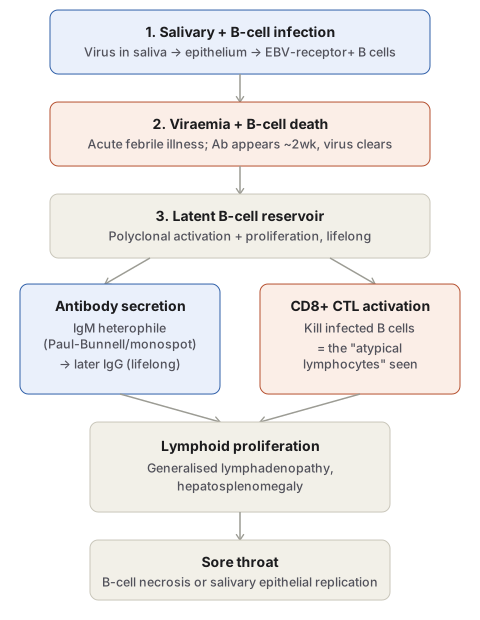
- In a susceptible, seronegative host, virus in contaminated saliva first invades and replicates within salivary gland epithelial cells, then infects B lymphocytes in lymphoid tissue, which carry EBV receptors; infection then spreads throughout the body via the bloodstream and via infected B cells.
- Viraemia and death of infected B cells produce the acute febrile illness; specific humoral antibodies appear and peak around 2 weeks post-infection, persisting lifelong — antibody appearance coincides with the virus disappearing from blood.
- Despite viral clearance from blood, EBV-infected B cells persist as a latent, lifelong reservoir. These latently infected B cells undergo polyclonal activation and proliferation, performing the two functions that are the diagnostic hallmark of IM:
- They secrete antibody — initially IgM (the heterophile anti-sheep-red-cell antibody used diagnostically), later IgG (persists for life, providing immunity against reinfection).
- They activate CD8+ cytotoxic T cells (CTLs), which kill the infected B cells — these activated CD8+ cells are precisely the pathognomonic atypical lymphocytes seen on the blood film in IM (i.e. the “atypical lymphocytes” of IM are reactive host CD8+ T cells, not infected B cells).
- Proliferation of these cells produces the generalised lymphadenopathy and hepatosplenomegaly of IM.
- The sore throat results from either B-cell necrosis or ongoing viral replication within salivary epithelium during the early stage.
Clinical Features
Incubation period 30–50 days in young adults (shorter in children), followed by a 3–5 day prodromal period (mild malaise, myalgia, headache, fatigue), then frank clinical illness lasting 7–21 days, with complete recovery typically by 2 months:
- Fever (90%), sore throat (80%), bilateral cervical lymphadenopathy (95%) — the core triad.
- Splenomegaly (50%), hepatomegaly (10%), transient erythematous maculopapular truncal/extremity rash (10%), periorbital oedema (10%), jaundice (5%).
Complications (uncommon, since most cases are self-limited): neurologic manifestations in children; splenic rupture from splenitis (a feared complication, relevant to activity restriction advice); upper airway obstruction from hypertrophied adenotonsillar tissue; cold-antibody autoimmune haemolytic anaemia; bacterial superinfection; and rarely myocarditis, hepatitis, or pneumonia.
Laboratory Findings
Haematologic:
- Moderate leucocytosis (10,000–20,000/µL), peaking in the 2nd–3rd week.
- Absolute lymphocytosis (both normal and atypical T lymphocytes), with relative neutropenia.
- Atypical T cells (“mononucleosis cells”), at least 10–12% of lymphocytes, essential to the diagnosis: large lymphocytes (12–16 µm) with oval/kidney-shaped/lobate nuclei (fine chromatin, no nucleoli — an immature-looking but non-leukaemic pattern), abundant basophilic finely granular cytoplasm, sometimes vacuolated — classified as Downey type I, II, III (type I most frequent). Peak numbers occur days 7–10 of illness and may persist up to 2 months.
- Reversed CD4:CD8 ratio — markedly reduced CD4+, substantially raised CD8+.
- Thrombocytopenia, usually in the first 4 weeks.
Serologic:
- Heterophile antibody test (Paul–Bunnell test) — patient serum, after absorption with guinea pig kidney, agglutinates sheep/horse/cow red cells; a titre ≥40 in a symptomatic patient is diagnostic of acute IM. Peaks at 3 weeks (positive in 80–90%), remains positive ~3 months, so repeat testing may be needed; not demonstrable in children under 5 or the elderly. A rapid kit-based version (monospot) is now widely used. A similar antibody occurs in serum sickness, distinguished by differential absorption studies.
- EBV-specific antibody tests (useful when heterophile-negative): IgM anti-viral-capsid-antigen (VCA) rises early — most useful for acute diagnosis; IgG anti-VCA appears later and persists lifelong (marks past exposure, not acute infection); antibody to EBV nuclear antigen (EBNA) appears 3–6 weeks post-infection and also persists for life; antibody to early antigens is less useful diagnostically but stays elevated 3–6 months and is notably high in nasopharyngeal carcinoma and African Burkitt lymphoma; IgA anti-EBV antigen marks nasopharyngeal-carcinoma risk.
- EBV antigen/DNA detection by PCR (blood or CSF) when needed.
Liver function tests are abnormal in ~90% of cases: raised transaminases (SGOT/SGPT), raised alkaline phosphatase, mild hyperbilirubinaemia.
Clinical Relevance
- The atypical lymphocyte of IM being the host’s own reactive CD8+ CTL response, not the EBV-infected B cell itself, is the single most commonly misunderstood point in this topic and is worth stating explicitly whenever asked to explain the blood picture.
- Advising against contact sports/heavy exertion in the first few weeks of IM is a direct clinical consequence of the splenic-rupture risk from splenitis — not a generic “rest” recommendation.
- A patient who is heterophile-antibody-negative but clinically convincing for IM (common in young children) requires EBV-specific serology (IgM anti-VCA) rather than being dismissed as not having IM, since heterophile antibodies are frequently absent in this age group.
- Elevated antibody to EBV early antigens, or IgA anti-EBV antibody, in a patient without classic IM symptoms should raise consideration of EBV-associated malignancy (nasopharyngeal carcinoma, Burkitt lymphoma) rather than acute mononucleosis, since these serologic patterns are characteristically associated with the oncogenic rather than the self-limited presentation of EBV infection.
Diagram 1: Pathogenesis of Infectious Mononucleosis
Draw a single downward column of three stages, then branch into two boxes (antibody secretion, CD8+ CTL activation), converging into lymphoid proliferation and then a final sore-throat box.
- Salivary and B-cell infection — virus infects epithelium, then EBV-receptor-bearing B cells.
- Viraemia and B-cell death — the acute febrile illness; antibody appears as virus clears from blood.
- Latent B-cell reservoir — persists lifelong, undergoes polyclonal activation.
- Branch: antibody secretion (IgM heterophile → IgG) and CD8+ CTL activation (kills infected B cells — label this branch explicitly as the source of the atypical lymphocytes).
- Converge: lymphoid proliferation — generalised lymphadenopathy, hepatosplenomegaly.
- Sore throat — from B-cell necrosis or salivary epithelial viral replication.
Labels required
- The CD8+ CTL branch must be explicitly labelled as the origin of the atypical (“mononucleosis”) lymphocytes seen on the blood film — this is the fact most often stated backwards (attributing the atypical cells to the infected B cells rather than to the reactive T-cell response against them).
- The latency step must be shown as a distinct stage from the acute viraemic phase, since it is what explains lifelong EBV carriage after clinical recovery.
Errors commonly made
- Describing the atypical lymphocytes of IM as EBV-infected B cells, when they are in fact the host’s reactive CD8+ cytotoxic T cells responding to the infected B cells.
- Treating antibody appearance and viral clearance from blood as unrelated events rather than as coincident — the appearance of antibody is what marks the disappearance of virus from the circulation, even though the B-cell reservoir persists.
My Sticky Notes
Personal revision notes, mnemonics and reminders.
