
Infarction
Definition
Tissue necrosis (usually coagulative; LIQUEFACTIVE in brain) from ischaemia. Localised area = infarct.
Aetiology
Mostly arterial occlusion (ischaemic necrosis) > venous obstruction (stagnant hypoxia). Usually sudden/complete/continuous (thrombosis/embolism), but can be non-occlusive (e.g. incomplete coronary narrowing + ↑demand → MI).
Factors influencing development (KEY — 3 factors)
- Vascular anatomy — dual supply (lung=pulm+bronchial; liver=hepatic artery+portal vein; forearm=radial+ulnar) = RESISTANT. End-arterial (kidney, spleen) = infarcts readily.
- Rate of occlusion — slow = collaterals develop (e.g. gradual coronary occlusion via plaque, interarteriolar anastomoses compensate); sudden = no time to compensate.
- Tissue hypoxia tolerance — neurons 3-4min > myocardium 20-30min > fibroblasts (hours).
Types
By colour: pale/anaemic (arterial, compact/end-arterial organs — kidney, heart, spleen) vs red/haemorrhagic (soft tissue, pulmonary arterial or dual-supply organs — lung, intestine). By age: recent vs old. By infection: bland vs septic (infected embolus → infarct becomes ABSCESS, more inflammation, heals by organisation+fibrosis).
Pathogenesis (7 steps)
- Localised hyperaemia (immediate)
- Oedema + haemorrhage (hours; more in lung/spleen)
- Coagulative necrosis (12-48h)
- Proteolysis + RBC lysis
- Peripheral acute inflammation (neutrophil→macrophage/fibroblast)
- Pigment deposition (haematoidin, haemosiderin) → pale-grey
- Organisation → fibrous scar ± dystrophic calcification
Morphology (general)
Gross: wedge-shaped (apex=occluded vessel, base=surface), arterial=pale/venous=haemorrhagic, MOST pale over time EXCEPT pulmonary (never pales, too much blood); cerebral = poorly defined, central softening (encephalomalacia); recent=raised, old=shrunken/depressed.
Micro: coagulative necrosis (pathognomonic) except liquefactive in brain → gliosis/gitter cells (lipid-laden microglia). Peripheral inflammation evolves neutrophil→macrophage/fibroblast. Eventually fibrous scar ± calcification.
Organ infarcts
- Lung — PA embolism doesn’t always infarct (bronchial supply); needs compromised circulation (CHF, chronic lung disease). Wedge, pleural base, haemorrhagic, lower lobes, fibrinous pleuritis. Coagulative necrosis of alveolar walls.
- Kidney — common (5% autopsies), thromboemboli (cardiac source mainly). Pale wedge, subcapsular base, spared thin rim (capsular vessels). Colour evolution: red(d1-3)→pale yellow(d4)→anaemic/depressed(wk1). Ghost tubules/glomeruli.
- Spleen — common site, cardiac thromboemboli mainly (also myeloproliferative/sickle cell/arteritis/Hodgkin’s/bacterial). Pale wedge, peripheral base, hilar apex.
- Liver — RARE (dual supply). Portal vein obstruction (cirrhosis, HCC/pancreatic Ca invasion, pylephlebitis) → infarct of Zahn (NOT true infarct — red-blue area, atrophy+sinusoidal dilatation, NO necrosis). Hepatic artery obstruction (arteritis, emboli) → TRUE ischaemic infarct, usually pale.
| Organ | Gross | Outcome |
|---|---|---|
| Myocardial | Pale | Frequently lethal |
| Pulmonary | Haemorrhagic | Less fatal |
| Cerebral | Haemorrhagic/pale | Fatal if massive |
| Intestinal | Haemorrhagic | Frequently lethal |
| Renal/splenic/hepatic/limb | Pale | Not lethal (unless massive/bilateral for renal) |
Clinical relevance
Dual-supply vs end-arterial predicts infarct susceptibility — lung/liver protected, kidney/spleen not. Ischaemic tolerance times = basis of “time is tissue” in stroke/MI management. Infarct of Zahn = non-ischaemic mimicker, don’t confuse with true hepatic infarct. Septic infarct→abscess = needs source control+antibiotics, different from bland infarct management.
Definition
Infarction is tissue necrosis — usually coagulative, except in the brain, where it is liquefactive — resulting from ischaemia; the localised area of necrosis produced is an infarct.
Aetiology
Most infarcts follow interruption of arterial blood supply (ischaemic necrosis); less commonly, venous obstruction produces infarction (stagnant hypoxia). Generally, sudden, complete and continuous occlusion (thrombosis, embolism) is required, though infarction can also result from non-occlusive circulatory insufficiency — e.g. incomplete atherosclerotic coronary narrowing producing myocardial infarction during acute coronary insufficiency (increased demand without complete occlusion).
Factors Influencing Infarct Development
Three variables determine whether vascular occlusion actually produces an infarct, and to what extent:
- Anatomy of the vascular supply — the single most important factor. Organs with a dual blood supply (lung — pulmonary + bronchial arteries; liver — hepatic artery + portal vein; forearm/hand — radial + ulnar arteries) resist infarction, since occlusion of one supply alone is often insufficient. Organs with an end-arterial circulation (kidney, spleen) infarct readily on arterial occlusion, since there is no alternative supply.
- Rate of occlusion — slowly developing occlusion allows time for collateral vessels to enlarge and compensate; a coronary artery occluded gradually by an advancing atherosclerotic plaque may recruit sufficient interarteriolar collateral flow to prevent infarction even once fully occluded, whereas the same degree of occlusion occurring suddenly would not.
- Tissue vulnerability to hypoxia — differs by basal metabolic need: neurons suffer irreversible injury after only 3–4 minutes of ischaemia; myocardial cells, somewhat hardier, after 20–30 minutes; fibroblasts remain viable for many hours of ischaemia.
Types of Infarcts
- By colour: pale (anaemic) infarcts — arterial occlusion in compact, end-arterial organs (kidney, heart, spleen); red (haemorrhagic) infarcts — soft, loosely-structured tissue, either from pulmonary arterial obstruction (lung) or arterial/venous occlusion in organs with abundant collateral/dual flow allowing blood to re-enter the necrotic area (intestine).
- By age: recent (fresh) or old (healed).
- By infection status: bland (sterile) or septic (infected — e.g. embolisation of an infected valve vegetation converts the infarct into an abscess, with a correspondingly greater inflammatory response and healing by organisation/fibrosis).
Pathogenesis
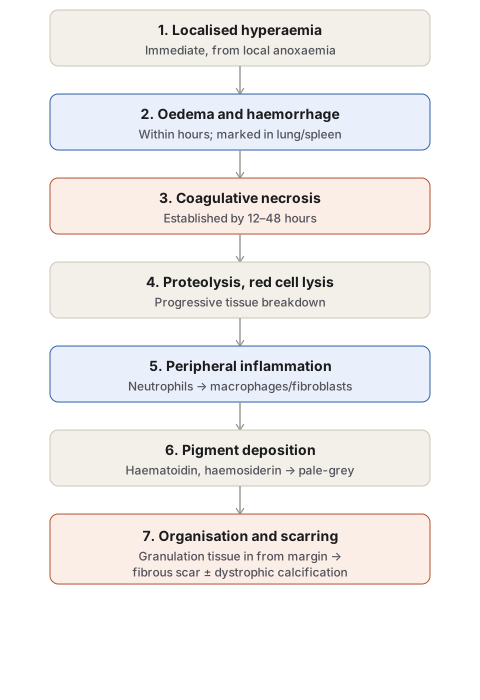
- Localised hyperaemia — from local anoxaemia, immediately after occlusion.
- Oedema and haemorrhage — within a few hours; more marked in lung/spleen, less in kidney/heart.
- Cell injury progressing to necrosis — early reversible change (cloudy swelling/degeneration), with irreversible cell death (coagulative necrosis, except liquefactive in brain) established by 12–48 hours.
- Proteolysis and red cell lysis — progressive breakdown of necrotic tissue.
- Peripheral acute inflammatory reaction — hyperaemia and inflammation at the margin, responding to proteolytic breakdown products; initially neutrophilic, later macrophage/fibroblast-dominated.
- Pigment deposition — haematoidin and haemosiderin from lysed red cells accumulate; most infarcts turn pale-grey at this stage as red cells are cleared.
- Organisation and scarring — granulation tissue grows in progressively from the margin, ultimately replacing the infarct with fibrous scar; dystrophic calcification may follow.
General Morphology
Grossly: infarcts of solid organs are classically wedge-shaped, apex toward the occluded vessel, broad base at the organ surface (often with an overlying fibrinous exudate if the base is serosal); arterial-occlusion infarcts are pale, venous-occlusion infarcts haemorrhagic; most infarcts pale with time as red cells lyse, except pulmonary infarcts, which never become pale given the large blood volume involved; cerebral infarcts are poorly defined with central softening (encephalomalacia) rather than a clean wedge; recent infarcts are slightly raised, old infarcts shrunken and depressed.
Microscopically: the pathognomonic feature is coagulative necrosis (liquefactive in the brain); some haemorrhage is usually present; peripheral inflammation evolves from neutrophilic to macrophage/fibroblast-dominated; the necrotic area is eventually replaced by fibrous scar, sometimes with dystrophic calcification. In the brain specifically, liquefactive necrosis is followed by gliosis — replacement by lipid-laden microglial cells (gitter cells).
Infarcts of Individual Organs
- Lung — pulmonary artery embolism does not always cause infarction, since the bronchial circulation provides a second supply; infarction occurs mainly when circulation is already compromised (chronic lung disease, congestive heart failure). Grossly, wedge-shaped, base on pleura, haemorrhagic, most often in lower lobes, with fibrinous pleuritis overlying; cut surface dark purple, with the occluding vessel visible near the apex; organised infarcts become retracted fibrous scars. Microscopically, coagulative necrosis of alveolar walls, initial neutrophilic infiltrate and capillary congestion, later replaced by haemosiderin-laden phagocytes and granulation tissue.
- Kidney — common (up to 5% of autopsies), chiefly thromboembolic (cardiac mural thrombi, MI, endocarditis vegetations, aortic aneurysm), less often from renal artery atherosclerosis, arteritis, sickle cell disease. Often multiple, may be bilateral; pale, wedge-shaped, base under the capsule, apex toward the medulla, with a thin spared subcapsular rim (capsular vessel supply); red/congested in the first 2–3 days, pale yellow by day 4, anaemic and depressed by one week. Microscopically, coagulative necrosis with “ghost” tubules and glomeruli (preserved outlines, lost nuclei/cytoplasmic detail), peripheral acute-then-organising inflammation.
- Spleen — a common infarction site, from splenic artery/branch occlusion, chiefly cardiac thromboemboli (mural thrombi, endocarditis, MI), less often microcirculatory obstruction (myeloproliferative disease, sickle cell anaemia, arteritis, Hodgkin disease, bacterial infection). Often multiple, pale/anaemic, wedge-shaped, base at the periphery, apex toward the hilum. Microscopically similar to renal infarcts — coagulative necrosis, inflammation, eventual shrunken fibrous scar.
- Liver — infarction is uncommon owing to dual blood supply (hepatic artery + portal vein). Portal vein obstruction (secondary to cirrhosis, hepatocellular or pancreatic carcinoma invasion, pylephlebitis) usually does not cause true ischaemic infarction but instead a distinct entity — the infarct of Zahn — a sharply defined red-blue area of reduced portal flow producing chronic hepatocyte atrophy and sinusoidal dilatation, without true necrosis. Hepatic artery obstruction (arteritis, arteriosclerosis, bland/septic emboli) does produce true ischaemic infarction, usually pale but occasionally haemorrhagic from portal blood stuffing the necrotic area.
| Location | Gross appearance | Outcome |
|---|---|---|
| Myocardial infarction | Pale | Frequently lethal |
| Pulmonary infarction | Haemorrhagic | Less commonly fatal |
| Cerebral infarction | Haemorrhagic or pale | Fatal if massive |
| Intestinal infarction | Haemorrhagic | Frequently lethal |
| Renal infarction | Pale | Not lethal unless massive/bilateral |
| Splenic infarction | Pale | Not lethal |
| Hepatic infarction | Pale | Not lethal |
| Lower extremity infarction | Pale | Not lethal |
Clinical Relevance
- The dual-supply vs end-arterial distinction directly predicts which organs “protect themselves” against infarction — lung and liver rarely infarct from single-vessel occlusion, while kidney and spleen infarct readily, which is exactly why pulmonary and hepatic infarction require additional compromise (pre-existing lung disease, combined arterial+portal insult) to actually occur.
- The specific ischaemic tolerance times (neurons 3–4 min, myocardium 20–30 min, fibroblasts hours) are the biological basis for why “time is tissue” in stroke and myocardial infarction management, and for why a graft or flap composed largely of fibrous tissue tolerates transiently interrupted blood supply far better than one containing neural or myocardial elements.
- Recognising the infarct of Zahn as a non-ischaemic portal-flow phenomenon — distinct from a true hepatic artery-occlusion infarct — avoids miscategorising a liver lesion that shows atrophy and sinusoidal dilatation rather than genuine coagulative necrosis.
- A septic infarct converting into an abscess (rather than resolving via ordinary organisation) explains why embolic events from an infected source (endocarditis vegetation) require a different clinical response — source control and antibiotics — than a bland thromboembolic infarct.
Diagram 1: Pathogenesis of Infarction
Draw a single downward column of seven stages, each carrying its approximate timing where known.
- Localised hyperaemia — immediate.
- Oedema and haemorrhage — within hours.
- Coagulative necrosis — established by 12–48 hours.
- Proteolysis and red cell lysis.
- Peripheral inflammation — neutrophils, then macrophages/fibroblasts.
- Pigment deposition — haematoidin, haemosiderin, producing the pale-grey appearance.
- Organisation and scarring — granulation tissue in from the margin, final fibrous scar.
Labels required
- The 12–48 hour timing for established necrosis must be retained explicitly, since this is a specific, frequently tested interval (e.g. relevant to when gross/histologic infarct changes first become reliably visible).
- The exception for brain (liquefactive necrosis, followed by gliosis/gitter cells rather than fibrous scar) should be noted as a side annotation, since the general sequence otherwise assumes coagulative necrosis.
Errors commonly made
- Describing necrosis as occurring immediately upon vascular occlusion, rather than as the endpoint of a sequence that begins with reversible hyperaemia and oedema and only becomes irreversible after a delay.
- Applying the fibrous-scar endpoint uniformly to the brain, omitting that cerebral infarcts instead undergo liquefaction and gliosis rather than being replaced by fibrous connective tissue.
My Sticky Notes
Personal revision notes, mnemonics and reminders.
