
Haemolytic Disease of the Newborn
Overview
HDN = maternal IgG antibodies cross placenta → destroy foetal RBCs. Sensitisation from pregnancy, prior abortion, or transfusion. Two forms: Rh incompatibility or ABO incompatibility — different mechanism, timing, severity.
Rh-D incompatibility HDN
Rh-negative mother sensitised to Rh-positive foetal cells (mainly via haemorrhage at parturition, not much crosses during pregnancy itself). Sensitisation MORE likely if mother+foetus ABO-COMPATIBLE (paradox: ABO incompatibility protects — mother’s own anti-A/anti-B destroys leaked foetal cells before they trigger anti-D).
~95% cases = anti-D (± anti-C/anti-E, rarely anti-C alone). Risk small in 1st pregnancy, ↑ in later pregnancies if anti-D immunoglobulin not given within 72hr of first delivery. Father Rh homozygous → all babies Rh+. Father heterozygous → 50% chance Rh-negative (unaffected) baby.
ABO incompatibility HDN
~20% of ABO-incompatible pregnancies affected. Naturally-occurring anti-A/anti-B = IgM, don’t cross placenta. IMMUNE (IgG) anti-A/anti-B cross and cause damage. Commonest in group O mothers (carry IgG anti-A/anti-B).
Differs from Rh-D HDN:
- Can occur in FIRST pregnancy
- Direct Coombs test usually NEGATIVE
- LESS severe
Clinical features
Severest (Rh-D): intrauterine death, hydrops foetalis. Moderate: severe anaemia+jaundice (unconjugated hyperbilirubinaemia); bilirubin >20mg/dl → kernicterus (basal ganglia bile pigment deposit) → permanent brain damage. Mild: anaemia only.
Lab findings
Cord blood: anaemia, reticulocytosis, ↑bilirubin, positive direct Coombs (if Rh-D+ cord blood). Maternal blood: Rh-D negative, high anti-D titre.
Course/prevention/treatment
Range: death → minimal haemolysis → mental retardation. Anti-D immunoglobulin to mother pre/post-delivery — clears foetal Rh+ cells before they sensitise her — reduces incidence. Exchange transfusion of baby — removes maternal antibodies + susceptible RBCs + lowers bilirubin.
Clinical relevance
ABO incompatibility protecting against Rh sensitisation is counterintuitive and testable — “more incompatibility” (ABO) actually protects against a MORE dangerous incompatibility (Rh). Anti-D prophylaxis = classic example of preventing disease by intercepting the sensitising event itself, not treating downstream — the 72hr window makes sense once you understand it’s about beating the mother’s primary immune response to the timing. ABO-HDN vs Rh-D HDN three-way contrast (1st pregnancy vs later / Coombs-neg vs Coombs-pos / mild vs severe) rewards understanding IgM vs IgG antibody class, not rote memorisation.
Overview
Haemolytic disease of the newborn (HDN) results from the passage of maternal IgG antibodies across the placenta into the foetal circulation, where they bind and destroy foetal red cells. Maternal sensitisation may arise from pregnancy itself, or from prior abortions or blood transfusion. HDN occurs from incompatibility of either the Rh or the ABO blood group system — the two forms differ substantially in mechanism, timing, and severity.
HDN Due to Rh-D Incompatibility
Occurs when an Rh-negative mother is sensitised to Rh-positive blood — most often from a Rh-positive foetus, via foetal red cells crossing the placenta into the maternal circulation. Very few foetal red cells cross during pregnancy itself, but haemorrhage at parturition causes significant sensitisation. Sensitisation is, somewhat counterintuitively, more likely when mother and foetus are ABO-compatible than when they are ABO-incompatible (in ABO incompatibility, the mother’s own naturally-occurring anti-A/anti-B antibodies destroy the leaked foetal cells before they can immunise her against the D antigen).
- Approximately 95% of cases are due to anti-D; some involve anti-D combined with other Rh antibodies (anti-C, anti-E), and rarely anti-C alone.
- The risk of sensitisation in an Rh-negative woman married to an Rh-positive man is small in the first pregnancy but increases in successive pregnancies if prophylactic anti-D immunoglobulin is not given within 72 hours of the first delivery.
 - Paternal Rh genotype determines foetal risk: if the father is Rh-D **homozygous**, all offspring will be Rh-D positive; if **heterozygous**, there is a 50% chance of an Rh-D negative (unaffected) child.
HDN Due to ABO Incompatibility
Occurs in about 20% of pregnancies with ABO incompatibility between mother and foetus. Naturally-occurring anti-A/anti-B antibodies are usually IgM and do not cross the placenta; it is the immune (IgG-class) anti-A/anti-B antibodies that cross into the foetal circulation and cause damage. ABO-HDN occurs most frequently in infants born to group O mothers, who characteristically carry IgG-class anti-A and/or anti-B.
ABO-HDN differs from Rh(D)-HDN in three important ways:
- It can occur in the first pregnancy (no prior sensitising exposure is needed, since anti-A/anti-B of some IgG fraction can already be present).
- The direct Coombs’ (antiglobulin) test is generally negative.
- It is less severe overall than Rh-D HDN.
Clinical Features
Severity spans a wide spectrum, most pronounced in Rh-D incompatibility:
- Severest form — intrauterine death from hydrops foetalis.
- Moderate disease — the baby is born with severe anaemia and jaundice from unconjugated hyperbilirubinaemia; if unconjugated bilirubin exceeds 20 mg/dl, bile pigment deposits in the basal ganglia (kernicterus), causing permanent brain damage.
- Mild disease — anaemia only, with or without jaundice.
Laboratory Findings
- Cord blood: variable anaemia, reticulocytosis, elevated serum bilirubin, and a positive direct Coombs’ test if the cord blood is Rh-D positive (i.e. in Rh-D HDN).
- Maternal blood: Rh-D negative, with a high plasma titre of anti-D.
Course, Prevention, and Treatment
Course ranges from death to minimal haemolysis to mental retardation (from kernicterus). Anti-Rh (anti-D) immunoglobulin given to the Rh-negative mother before or after delivery has substantially reduced the incidence of Rh-D HDN — it works by clearing foetal Rh-positive cells from the maternal circulation before they can sensitise her immune system. Exchange transfusion of the affected baby removes maternal antibodies, removes red cells susceptible to further haemolysis, and lowers bilirubin levels.
Clinical Relevance
- The counterintuitive protective effect of ABO incompatibility against Rh sensitisation (the mother’s own anti-A/anti-B destroying leaked foetal cells before they can trigger anti-D formation) is a genuinely testable point that inverts the naive expectation that “more incompatibility means more risk” — here, one incompatibility (ABO) actually protects against a different, more dangerous one (Rh).
- Anti-D immunoglobulin prophylaxis is one of the clearest examples in obstetric medicine of preventing a disease by intercepting the sensitising event itself, rather than treating its downstream consequences — understanding why it must be given within 72 hours of delivery (before the mother’s own immune system mounts a primary response to the leaked foetal Rh-positive cells) is what makes the timing rule make sense rather than being an arbitrary number to memorise.
- The three-way contrast between ABO-HDN and Rh-D HDN (first pregnancy vs subsequent pregnancy, Coombs-negative vs Coombs-positive, mild vs potentially severe) is a compact, frequently tested comparison that rewards understanding the underlying antibody class (IgM vs IgG) and pre-existing sensitisation status rather than rote memorisation of each fact in isolation.
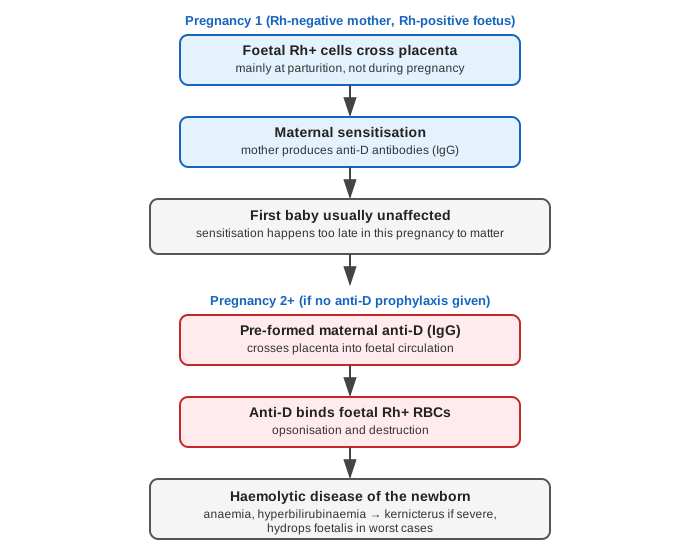
Diagram 1: Rh-D Sensitisation Across Pregnancies
Draw two stacked timelines, “Pregnancy 1” and “Pregnancy 2+”, each a vertical chain, with the outcome box of Pregnancy 1 feeding conceptually into the start of Pregnancy 2+.
Pregnancy 1: Foetal Rh+ cells cross placenta (mainly at parturition) → maternal sensitisation (anti-D IgG produced) → first baby usually unaffected (too late in that pregnancy to matter).
Pregnancy 2+ (no anti-D prophylaxis): Pre-formed maternal anti-D crosses placenta early → binds foetal Rh+ RBCs → destruction → HDN (anaemia, hyperbilirubinaemia → kernicterus if severe; hydrops foetalis in worst cases).
Labels required
- The timing distinction (“mainly at parturition” for exposure, “too late to matter” for the first pregnancy’s outcome) must be explicit — this is the detail that explains why the first pregnancy is usually spared while later ones are not.
- The role of anti-D prophylaxis must be identifiable as intervening at the sensitisation step (end of Pregnancy 1), not at the destruction step (Pregnancy 2+) — it works by preventing antibody formation in the first place, not by treating an already-sensitised mother.
Errors commonly made
- Assuming Rh-D HDN can occur in a first pregnancy — it essentially cannot, because sensitisation itself takes time and typically happens only at delivery, after the baby is already born.
- Confusing this timeline with ABO-HDN, which does not require this two-pregnancy sensitisation sequence because some IgG anti-A/anti-B may already be present without prior foetal exposure.
My Sticky Notes
Personal revision notes, mnemonics and reminders.
