
Glucose-6-Phosphate Dehydrogenase Deficiency
Overview
RBCs protected from oxidant stress by reduced glutathione (GSH), made via hexose monophosphate (HMP) shunt. G6PD = rate-limiting enzyme of this shunt; deficiency = commonest red cell enzymopathy. >400 variants, few clinically significant.
X-linked gene. Affected males: uniformly deficient RBCs. Heterozygous females: two cell populations (normal + deficient) from random X-inactivation — usually unaffected unless “unfavourable lyonization” (large deficient-cell proportion by chance).
Variants
- Type B — normal
- G6PD A+ — normal Black variant
- G6PD A− — commonest significant variant, Black males, malaria-protective (like HbS). Only modestly ↓half-life → only OLDER cells vulnerable → marrow compensates with new adequate-G6PD cells → haemolysis self-limiting even if exposure continues
- G6PD Mediterranean — Middle East, more severe deficiency → more severe haemolysis
Pathogenesis
↓GSH regeneration → oxidants (from infection-driven phagocyte H2O2, or drugs) attack globin chains → hemoglobin denatures/precipitates → Heinz bodies → membrane damage → intravascular haemolysis in worst cells. Less-damaged cells: splenic macrophages “pluck out” Heinz bodies → bite cells → trapped/destroyed in spleen.
Precipitants
Drugs (primaquine, sulfonamides, nitrofurantoin, phenacetin, high-dose aspirin, vit K), infection (commonest trigger — host’s own oxidants, not the organism), fava beans (favism), metabolic acidosis.
Clinical features
Acute haemolytic anaemia within hours-days of exposure, self-limiting (A− variant). Neonatal jaundice — can progress to kernicterus. Between crises: no anaemia, mildly ↓RBC survival.
Lab findings
Acute: ↓Hct 25-30%, intravascular haemolysis markers (↑plasma Hb, haemoglobinuria, ↑unconjugated bilirubin, ↓haptoglobin). Heinz bodies (crystal violet stain) — only first 1-2 days, then spleen removes them → bite cells + fragmented cells instead. Diagnosis: MRT, fluorescent screening test, ascorbate-cyanide test, or direct enzyme assay (definitive).
Treatment
Stop offending drug/exposure — prevent further crises. Transfusion rarely needed.
Clinical relevance
G6PD A− persisting in malaria-endemic areas despite causing haemolysis = same heterozygote-advantage logic as sickle cell trait — recognise as a pattern, not two separate facts. Infection (not the drug itself) is usually the actual haemolysis trigger — host’s own phagocyte oxidants, easy to miss. Self-limiting course in A− variant (old deficient cells lyse first, new cells adequate until they age) — changes management expectations vs other haemolytic anaemias. Heinz bodies vs bite cells = different disease stages, not interchangeable — Heinz bodies mark acute phase, disappear in 1-2 days, bite cells are what’s left after splenic removal.
Overview
Red cells are constantly exposed to oxidant stress, both from their environment and as a by-product of normal metabolism, and are normally protected by reduced glutathione (GSH), generated via the hexose monophosphate (HMP) shunt. Glucose-6-phosphate dehydrogenase (G6PD) is the rate-limiting enzyme of this shunt; its inherited deficiency is the most common red cell enzymopathy, affecting millions of people worldwide. More than 400 G6PD variants have been identified, though only a few cause clinically significant disease.
The G6PD gene is on the X chromosome, making deficiency an X-linked trait: affected males have red cells that are uniformly deficient, while heterozygous females carry two red cell populations (one normal, one deficient) owing to random X-inactivation (lyonization) — most carrier females are unaffected, except in the chance situation of unfavourable lyonization, where a large proportion of their red cells happen to be the deficient population.
Variants
- Type B — the normal G6PD variant.
- G6PD A+ — the normal variant found in Black populations.
- G6PD A− (A-negative) — the most common clinically significant variant, found in Black males; confers a survival advantage against malaria (paralleling the HbS gene), similar to the logic behind sickle cell trait’s persistence. Enzyme half-life is only modestly decreased, so only older red cells are vulnerable; because the marrow compensates by producing new red cells with adequate G6PD, haemolysis is self-limiting even if oxidant exposure continues.
- G6PD Mediterranean — found mainly in the Middle East; produces more marked enzyme deficiency, so haemolysis on oxidant exposure is considerably more severe than with the A− variant.
Pathogenesis
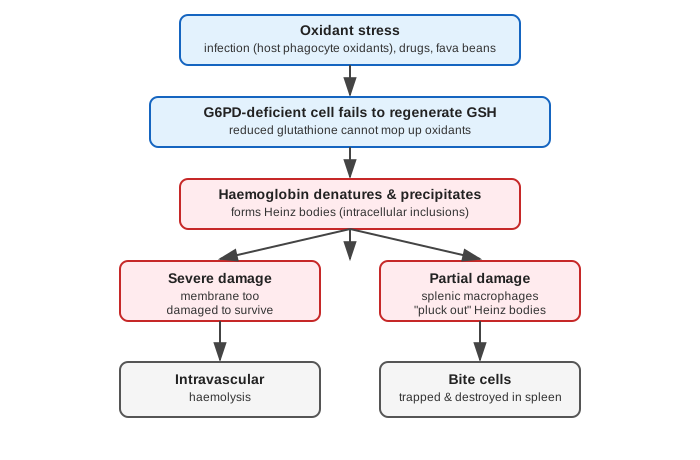
G6PD deficiency leaves red cells unable to regenerate adequate GSH, so oxidants generated during infection (phagocytes producing hydrogen peroxide as part of the host response) or introduced by certain drugs are free to attack red cell components, including hemoglobin’s globin chains. Oxidised hemoglobin denatures and precipitates into intracellular inclusions called Heinz bodies, which damage the red cell membrane severely enough to cause intravascular haemolysis in the worst-affected cells. Less severely damaged cells lose deformability as splenic phagocytes attempt to “pluck out” the Heinz bodies, transforming them into bite cells — these become trapped and destroyed on recirculation through the spleen.
Precipitants of Haemolysis
- Drugs — antimalarials (notably primaquine), sulfonamides, nitrofurantoin, phenacetin, high-dose aspirin, vitamin K derivatives.
- Infection — the most common trigger clinically; the host’s own phagocyte-generated oxidants during infection precipitate the crisis, rather than the infecting organism directly.
- Fava bean ingestion (favism).
- Metabolic acidosis.
Clinical Features
- Acute haemolytic anaemia develops within hours to a few days of oxidant exposure; haemolysis is typically self-limiting even with continued exposure (in the A− variant), since the marrow-produced new red cells carry adequate G6PD until they too age.
- Neonatal jaundice — infants with G6PD deficiency may develop unconjugated hyperbilirubinaemia severe enough to progress to kernicterus.
- Between haemolytic crises, the affected individual is generally not anaemic, though red cell survival remains modestly shortened.
Laboratory Findings
- During acute haemolysis: rapid fall in haematocrit (25–30%), features of intravascular haemolysis — raised plasma haemoglobin, haemoglobinuria, raised unconjugated bilirubin, fallen plasma haptoglobin.
- Heinz bodies — demonstrated by supravital stains (e.g. crystal violet) during the acute episode; not seen after the first 1–2 days, since the spleen removes them, leaving bite cells and fragmented red cells instead.
- Diagnostic screening tests: methaemoglobin reduction test (MRT), fluorescent screening test, ascorbate-cyanide screening test — or direct enzyme assay on red cells for definitive diagnosis.
Treatment
Directed at preventing haemolytic episodes — identifying and stopping the offending drug/exposure. Blood transfusion is rarely required, given the self-limiting nature of most episodes.
Clinical Relevance
- The G6PD A− variant’s persistence in malaria-endemic populations, despite causing a haemolytic disorder, mirrors the same heterozygote-advantage logic taught for sickle cell trait — a genuinely recurring theme in red cell genetics worth recognising as a pattern rather than memorising twice as unrelated facts.
- Haemolysis being triggered more often by infection than by the precipitating drug itself is a frequently missed point: the oxidant stress driving the crisis usually comes from the host’s own phagocyte response to the infection, not the pathogen or the drug directly acting on the red cell.
- The self-limiting course of A− variant haemolysis (older, more deficient cells lyse first; new marrow-produced cells are adequately enzyme-replete until they age) explains why continued drug exposure does not necessarily worsen the crisis — a detail that changes clinical management expectations compared to other haemolytic anaemias.
- Bite cells and Heinz bodies are stage-dependent findings, not interchangeable — Heinz bodies mark the acute oxidative-damage phase and disappear within 1–2 days as the spleen removes them, at which point bite cells (the morphologic scar of that removal) become the visible finding instead.
Diagram 1: Oxidant-Induced Haemolysis Mechanism
Draw a top box (oxidant stress) feeding into a GSH-failure box, then a Heinz body box, which forks into two parallel severity-based outcomes converging on their respective fates.
- Oxidant stress — infection (host phagocyte oxidants), drugs, fava beans.
- G6PD-deficient cell fails to regenerate GSH.
- Haemoglobin denatures/precipitates — Heinz bodies form. 4a. Severe damage — intravascular haemolysis directly. 4b. Partial damage — splenic macrophages pluck out Heinz bodies → bite cells → trapped/destroyed in spleen.
Labels required
- The fork must be explicitly framed as a severity gradient of the same insult, not two unrelated mechanisms — both outcomes start from the same Heinz-body-forming event.
- Bite cells must be labelled as the morphologic consequence of splenic Heinz-body removal, not an independent finding — this is the detail most often memorised without understanding why bite cells look the way they do.
Errors commonly made
- Treating Heinz bodies and bite cells as simultaneously visible findings — Heinz bodies are only seen in the first 1–2 days before the spleen removes them, at which point bite cells appear instead; the two are sequential, not concurrent.
- Attributing haemolysis directly to the precipitating drug’s action on the red cell, when the more common real trigger is the oxidant burden generated by the host’s own phagocyte response during infection.
Multiple Choice Questions (1)
My Sticky Notes
Personal revision notes, mnemonics and reminders.
