
Familial Hypercholesterolaemia
Definition
Autosomal dominant “receptor disease.” Most common cause (80-85%): loss-of-function mutation in LDL receptor gene. Receptor loss removes normal feedback control on cholesterol synthesis → high cholesterol → early atherosclerosis, high MI risk. One of the commonest Mendelian disorders — heterozygote frequency ~1 in 500, ~20x higher in patients who already have atherosclerotic heart disease.
Normal cholesterol metabolism
~7% of body cholesterol circulates in plasma, mostly as LDL. Liver is central to both making and clearing it.
Path: Liver secretes VLDL (triglyceride-rich) → capillary lipolysis → IDL (less triglyceride, more cholesteryl ester) → most IDL taken up by liver via LDL receptor; rest loses more triglyceride+ApoE → becomes LDL. Two-thirds of LDL cleared by LDL receptor pathway (mostly on hepatocytes, ~75%); rest by scavenger receptor on monocytes/macrophages (this route rises directly with plasma cholesterol level).
LDL receptor pathway + feedback
LDL binds receptor → clathrin-coated pit → endosome → fuses with lysosome → receptor recycled to surface, LDL degraded → free cholesterol released (needs NPC1+NPC2 proteins to exit lysosome — same proteins defective in Niemann-Pick type C).
Free cholesterol then gives 3 feedback effects:
- Blocks HMG-CoA reductase → ↓new cholesterol synthesis (statin drug target)
- ↑Storage as cholesteryl esters
- ↓LDL receptor synthesis + ↑PCSK9 (this enzyme sends LDL receptor for degradation instead of recycling — a second independent brake)
Pathogenesis of FH — 3 causes, same result
- LDL receptor mutation (80-85%) — receptor doesn’t reach surface properly or doesn’t work
- ApoB-100 mutation (5-10%) — LDL particle’s own binding site is faulty, so even normal receptor can’t bind it
- PCSK9 mutation (1-2%, gain-of-function) — too much receptor degradation regardless of how many are made
All 3 → same result: poor LDL clearance + more LDL made (since IDL can’t enter liver properly either, more gets converted to LDL) → very high plasma cholesterol → scavenger receptor uptake in macrophages/vessel walls → xanthomas + early atherosclerosis.
Clinical features
Heterozygotes: cholesterol 2-3x normal from birth, but no symptoms till adulthood — then tendon xanthomas + early coronary disease. Homozygotes: much worse — cholesterol >5x normal, skin xanthomas in childhood, often die of MI before age 20.
Treatment
Statins (HMG-CoA reductase inhibitors) → more LDL receptors made. But body compensates by making more PCSK9, which degrades the new receptors — limits statin effect. This is why anti-PCSK9 drugs (antibodies, siRNA) were made for statin-resistant cases.
Clinical relevance
Heterozygote-vs-homozygote picture is a clean example of gene-dose effect — 1 working allele delays disease to adulthood; 0 working alleles compresses the same disease into childhood, with death from MI before age 20 a real outcome. PCSK9 feedback explains directly why statins alone plateau in effect and why anti-PCSK9 drugs were the logical next step, not a random alternative.
Definition
Familial hypercholesterolaemia (FH) is an autosomal dominant “receptor disease”, caused most commonly (80–85% of cases) by loss-of-function mutation in the gene encoding the LDL receptor, which normally transports and clears LDL cholesterol from the blood. Loss of receptor function removes the feedback control that normally holds cholesterol synthesis in check, producing elevated cholesterol that drives premature atherosclerosis and greatly increased myocardial infarction risk. FH is among the most common Mendelian disorders — heterozygote frequency roughly 1 in 500 in the general population, rising roughly 20-fold in patients with atherosclerotic cardiovascular disease.
Normal Cholesterol Metabolism
About 7% of the body’s cholesterol circulates in plasma, predominantly as LDL; the liver is central to both its synthesis and clearance. Dietary triglycerides/cholesterol are packaged into chylomicrons in intestinal mucosa, hydrolysed by endothelial lipoprotein lipase in muscle/fat capillaries, and delivered as cholesterol-rich chylomicron remnants to the liver.
Endogenous synthesis and clearance:
- The liver secretes triglyceride-rich VLDL.
- Capillary lipolysis converts VLDL to IDL (triglyceride content falls, cholesteryl ester content rises; VLDL-associated apolipoproteins B-100 and E remain on the surface).
- Most IDL is taken up by the liver via the LDL receptor; the remainder loses further triglyceride and apolipoprotein E, becoming cholesterol-rich LDL.
- Two-thirds of LDL is cleared by the LDL receptor pathway (which binds apolipoproteins B-100 and E, ~75% of receptors located on hepatocytes); the rest by a scavenger receptor for chemically modified (acetylated/oxidised) LDL, present on monocytes/macrophages — the amount cleared this way rises directly with plasma cholesterol level.
The LDL Receptor Pathway and Its Regulation
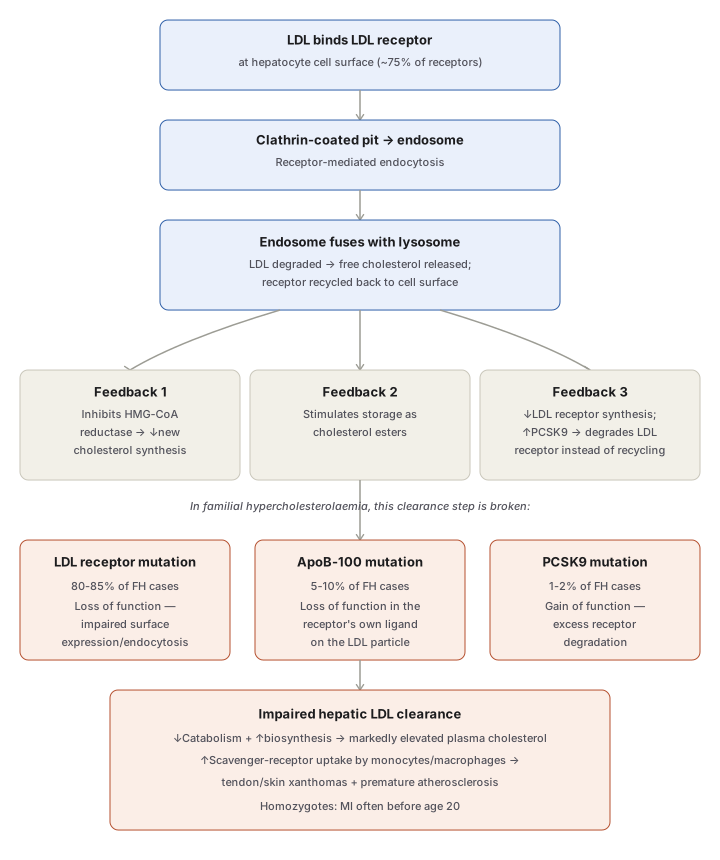
LDL bound to its surface receptor is internalised via clathrin-coated pits into endosomes, which fuse with lysosomes; the receptor is recycled to the surface while LDL is enzymatically degraded, releasing free cholesterol. Exit of cholesterol from the lysosome requires two further proteins, NPC1 and NPC2 (the same proteins defective in Niemann-Pick disease type C).
Free intracellular cholesterol then exerts negative feedback through three actions:
- Suppresses cholesterol synthesis by inhibiting HMG-CoA reductase, the rate-limiting synthetic enzyme — the target of statin drugs.
- Stimulates storage of excess cholesterol as cholesteryl esters.
- Downregulates LDL receptor synthesis, and upregulates PCSK9, an enzyme that diverts internalised LDL receptors toward lysosomal degradation instead of recycling — a second, independent brake on cholesterol accumulation.
Pathogenesis of FH
Three distinct molecular defects, all converging on impaired hepatic LDL clearance:
- LDL receptor mutation (80–85% of cases) — impairs surface expression or endocytosis of the receptor; over 2000 distinct mutations identified, the commonest producing a folding defect that prevents cell-surface expression at all.
- ApoB-100 mutation (5–10%) — loss-of-function in the receptor’s own ligand on the LDL particle itself, so even a normal receptor cannot bind LDL effectively.
- PCSK9 mutation (1–2%) — gain-of-function, causing excessive degradation of LDL receptors regardless of how many are made.
All three produce clinically indistinguishable disease: reduced catabolism combined with increased biosynthesis (since absent hepatic LDL receptors also impair IDL uptake, diverting more IDL toward LDL formation) produces markedly elevated plasma cholesterol. The resulting excess is taken up in large amounts by the scavenger receptor pathway in monocytes/macrophages and vascular walls, accounting for skin xanthomas and premature atherosclerosis.
Clinical Features
Heterozygotes show a 2–3-fold elevation in plasma cholesterol from birth but remain asymptomatic until adulthood, when tendon-sheath xanthomas and premature coronary artery disease develop. Homozygotes are far more severely affected — cholesterol elevated over 5-fold, cutaneous xanthomas appearing in childhood, and death from myocardial infarction often before age 20.
Treatment
Understanding the LDL receptor pathway directly produced the statin drug class — HMG-CoA reductase inhibitors that promote greater LDL receptor synthesis by relieving intracellular cholesterol’s inhibitory feedback. However, the resulting rise in LDL receptors is partly offset by a compensatory rise in PCSK9, which degrades the newly-made receptors — the rationale for newer agents (anti-PCSK9 antibodies, PCSK9-targeting siRNA) developed specifically for statin-refractory hypercholesterolaemia.
Clinical Relevance
The heterozygote/homozygote severity gradient is the clearest illustration in the whole topic of a true dose-dependent gene-product effect — one functional LDL receptor allele is enough to delay disease into adulthood, while zero functional alleles compresses the same disease process into childhood, with death from myocardial infarction before age 20 a real outcome, not a theoretical worst case. The PCSK9 feedback loop explains a specific prescribing observation directly: why statin monotherapy plateaus in effectiveness and why anti-PCSK9 therapy was developed as a rational next step rather than an arbitrary alternative drug class.
Diagram 1: The LDL Receptor Pathway and the Molecular Defect in FH
Draw a single downward column for the normal pathway (LDL binding → endocytosis → lysosomal processing), branching into three feedback boxes, then converging down into three parallel FH-defect boxes, then converging into one final outcome box.
- LDL binds LDL receptor at the cell surface.
- Clathrin-coated pit → endosome.
- Endosome fuses with lysosome → receptor recycled, LDL degraded to free cholesterol.
- Three feedback boxes: (a) inhibits HMG-CoA reductase, (b) stimulates cholesteryl ester storage, (c) downregulates LDL receptor synthesis + upregulates PCSK9.
- Three FH-defect boxes, parallel, each breaking the clearance step differently: LDL receptor mutation (80-85%), ApoB-100 mutation (5-10%), PCSK9 mutation (1-2%).
- Final outcome box: impaired hepatic LDL clearance → elevated plasma cholesterol → xanthomas + premature atherosclerosis.
Labels required
- The percentage breakdown (80-85% / 5-10% / 1-2%) must appear on all three FH-defect boxes — this is what tells a student LDL receptor mutation is overwhelmingly the “default” cause to think of first, while still knowing the other two exist.
- PCSK9’s role must be stated precisely as promoting receptor degradation instead of recycling — not simply “inhibits the receptor” — since this precision is what explains both the statin-PCSK9 compensatory rise and why PCSK9 gain-of-function (not loss-of-function) causes FH.
- The homozygote MI-before-age-20 fact belongs in the outcome box as the clearest illustration of dose-dependent severity.
Errors commonly made
- Treating PCSK9 mutation in FH as loss-of-function (by analogy with the LDL receptor and ApoB-100 defects) rather than correctly identifying it as gain-of-function — this reversal is a common and specifically tested error.
- Describing the three FH causes as producing three different diseases rather than one clinically indistinguishable disease reached by three different molecular routes.
- Omitting that statins’ effectiveness is partly self-limited by a compensatory rise in PCSK9 — treating statin therapy as acting on an otherwise-static system rather than one with its own negative feedback.
My Sticky Notes
Personal revision notes, mnemonics and reminders.
