
Edwards Syndrome
Definition
Trisomy 18. Extra copy of chromosome 18. Incidence ~1 in 8,000 births. Between Down syndrome (most common) and Patau syndrome (rarest) in frequency.
Cytogenetic types
- Standard trisomy — karyotype 47,+18. Meiotic nondisjunction. Most cases.
- Mosaic type — karyotype 46,XX/47,XX,+18. Nondisjunction after fertilisation. Milder phenotype.
Note: unlike Down syndrome and Patau syndrome, Edwards syndrome does not have a standard translocation-type classification.
Clinical features
Prominent occiput · intellectual disability · micrognathia (small jaw) · low-set ears · short neck · overlapping fingers (typical clenched hand posture) · congenital heart defects · renal malformations · limited hip abduction · rocker-bottom feet.
Clinical relevance
Edwards and Patau syndromes share some features (cardiac defects, rocker-bottom feet, intellectual disability), so the different features matter most for telling them apart: overlapping fingers + micrognathia + low-set ears + prominent occiput → think Edwards; microphthalmia + polydactyly + cleft lip/palate + umbilical hernia → think Patau. Both trisomies are much more severe than Down syndrome — this is why so few pregnancies with these trisomies survive to birth, compared to how often they are conceived.
Definition
Edwards syndrome (trisomy 18) is caused by an extra copy of chromosome 18, with an incidence of approximately 1 in 8000 live births — intermediate in frequency between Down syndrome (trisomy 21, most common) and Patau syndrome (trisomy 13, rarest of the three major autosomal trisomies).
Cytogenetic Types
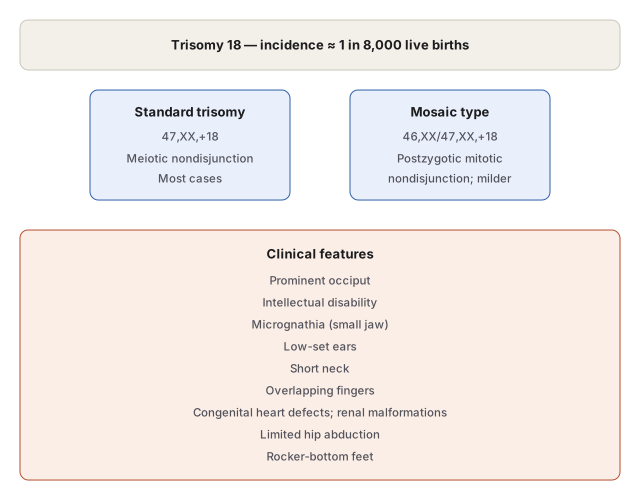
- Standard trisomy (karyotype 47,+18) — from meiotic nondisjunction; the great majority of cases.
- Mosaic type (karyotype 46,XX/47,XX,+18) — from postzygotic mitotic nondisjunction, producing a mixture of normal and trisomic cell lines and a correspondingly milder phenotype.
Unlike Down syndrome and Patau syndrome, a distinct translocation form of trisomy 18 is not a standard part of its classification.
Clinical Features
- Prominent occiput.
- Intellectual disability.
- Micrognathia (small jaw).
- Low-set ears.
- Short neck.
- Overlapping fingers — a characteristic clenched hand posture.
- Congenital heart defects.
- Renal malformations.
- Limited hip abduction.
- Rocker-bottom feet.
Clinical Relevance
Edwards syndrome and Patau syndrome share some overlapping features — cardiac defects, rocker-bottom feet, intellectual disability — which makes the distinguishing features the ones actually worth memorising for clinical or examination discrimination: overlapping fingers, micrognathia, low-set ears, and a prominent occiput point toward Edwards syndrome, while microphthalmia, polydactyly, cleft lip/palate, and umbilical hernia point toward Patau syndrome. Both trisomies carry a substantially graver prognosis than Down syndrome, reflected in their much lower live-birth incidence relative to the rate of conception — most affected pregnancies do not survive to term.
Diagram 1: Cytogenetic Types and Clinical Features
Draw two parallel karyotype boxes (standard, mosaic) above a single shared clinical-features box.
- Standard trisomy — 47,+18, meiotic nondisjunction, most cases.
- Mosaic type — 46,XX/47,XX,+18, postzygotic mitotic nondisjunction, milder.
- Shared features box — prominent occiput, intellectual disability, micrognathia, low-set ears, short neck, overlapping fingers, congenital heart defects, renal malformations, limited hip abduction, rocker-bottom feet.
Labels required
- Only two cytogenetic types should be drawn — deliberately omit a translocation-type box, since Edwards syndrome (unlike Down and Patau syndromes) is not classified with a standard translocation form.
- Overlapping fingers, micrognathia, and low-set ears should be visually or textually flagged as the features most useful for distinguishing Edwards syndrome from Patau syndrome at a glance.
- Note that umbilical hernia is a Down syndrome and Patau syndrome feature, not an Edwards syndrome feature — a frequently mixed-up point worth a deliberate exclusion label.
Errors commonly made
- Adding a translocation-type box out of habit, by analogy with Down and Patau syndromes, when the source classification for Edwards syndrome does not include one.
- Confusing Edwards syndrome’s features with Patau syndrome’s — both share cardiac defects, rocker-bottom feet, and intellectual disability, so the distinguishing features (overlapping fingers/micrognathia/low-set ears/prominent occiput for Edwards; microphthalmia/polydactyly/cleft lip-palate/umbilical hernia for Patau) must be actively distinguished rather than assumed interchangeable.
- Substituting “microcephaly” for Edwards syndrome’s actual described head finding, “prominent occiput” — the two are not the same finding, and only the latter is the one given for trisomy 18.
My Sticky Notes
Personal revision notes, mnemonics and reminders.
