
Down Syndrome
Overview
Trisomy 21 = extra chr21 copy. Most common chromosomal disorder + leading cause of severe intellectual disability. Incidence ~1/700 live births overall (rises steeply with maternal age).
3 cytogenetic types
1. Standard trisomy 21 (~95%) — 47,+21. Meiotic nondisjunction, 95% maternal origin. Strong maternal age link: 1/1550 (<20yo) → 1/25 (>45yo). Ovum ↑susceptibility to nondisjunction with age (reason unclear). No paternal-age effect. Parents chromosomally NORMAL → LOW recurrence risk.
2. Translocation type (~4%) — 46,der(14;21),+21 (or chr22). Robertsonian translocation fuses extra chr21 to chr14/22. NOT maternal-age related. Often FAMILIAL — parent carries balanced Robertsonian translocation (phenotypically normal) → HIGH recurrence risk. KEY EXCEPTION to “chromosomal disorders = sporadic/de novo” general rule.
3. Mosaic type (~1%) — mixed 46/47 chromosome cell lines. POST-zygotic mitotic nondisjunction (early embryogenesis, after fertilisation ≠ gametogenesis). Milder/VARIABLE severity (∝ % abnormal cells) — some near-average intelligence.
Clinical features
Face (usually apparent at birth): flat facial profile, oblique palpebral fissures, epicanthic folds, prominent occiput, micrognathia, low-set ears, abundant nuchal skin.
Other: single/simian palmar crease, gap 1st-2nd toe, hypotonia, slow growth.
Intellect: 80% have IQ 25-50. Mosaics: near-normal possible.
Major systemic associations
- Congenital heart disease (~40%) — endocardial cushion defects MOST COMMON (ASD, AV valve malformation, VSD). = MAJORITY of infant/early childhood deaths.
- GI — oesophageal+small bowel atresia, intestinal stenosis, Hirschsprung’s disease
- Leukaemia — 10-20x ↑risk (both ALL+AML)
- Alzheimer’s disease — VIRTUALLY ALL patients >40yo develop AD neuropathology (linked to extra APP gene dosage, chr21)
- Immune dysfunction — abnormal (mainly T-cell) responses → serious infections (esp. pulmonary) + thyroid autoimmunity (basis unclear)
- Other — cataracts/refractive errors, hearing loss, cryptorchidism, hypospadias
Prognosis
Median age at death now ~60yr (up from 25yr in 1983) — reflects improved cardiac/infection/haem complication management.
Molecular basis
Incompletely understood despite decades-known karyotype. Leading candidates: APP gene dosage (→AD link), chr21-encoded microRNA/lncRNA dysregulation. Causality not firmly established for any single mechanism.
Clinical relevance
3-mechanism framework = determines RECURRENCE RISK COUNSELLING (standard trisomy=low risk; translocation-carrier parent=high risk) → real clinical necessity, not just classification. Translocation exception to “sporadic” rule = highest-yield single fact in clinical cytogenetics (changes management/counselling). Maternal-age link = most clinically applied fact (prenatal screening basis). Near-universal AD after 40 (APP dosage) = chromosomal-dosage-effect example explaining puzzling systemic association.
Overview
Down syndrome (trisomy 21) is an extra copy of chromosome 21 and is the most common chromosomal disorder, as well as the leading cause of severe intellectual disability of chromosomal origin. Incidence approximately 1 in 700 live births overall, though risk rises steeply with maternal age.
Cytogenetic Types
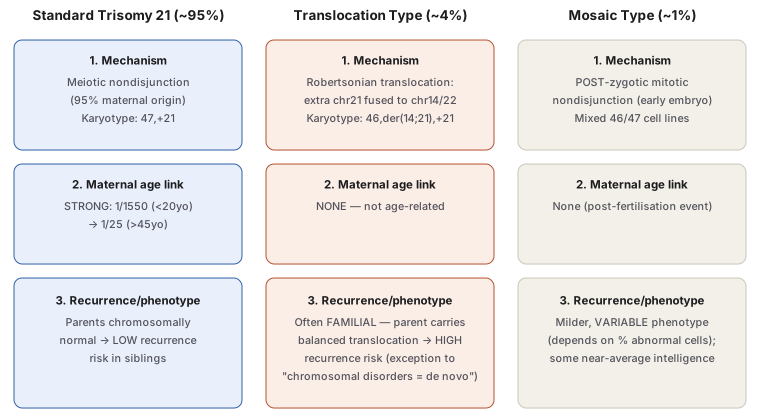
- Standard trisomy 21 (~95% of cases) — karyotype 47,+21. Arises from meiotic nondisjunction, in 95% of cases of maternal origin. Strongly correlated with maternal age: incidence rises from about 1 in 1550 live births in mothers <20 years to about 1 in 25 live births in mothers >45 years — the correlation suggests the ovum’s increased susceptibility to nondisjunction with advancing age, though the exact biological reason remains unclear. No paternal-age effect is seen in the minority of cases where the extra chromosome is of paternal origin. Parents are chromosomally normal, so recurrence risk in future pregnancies is low.
- Translocation type (~4% of cases) — karyotype 46,der(14;21),+21 (or equivalent involving chromosome 22). The extra chromosome-21 material is fused via Robertsonian translocation to chromosome 14 or 22. Not related to maternal age. Frequently — though not always — familial: the translocated chromosome is inherited from a parent who is a carrier of a balanced Robertsonian translocation (phenotypically normal themselves). This gives a substantially increased recurrence risk in future siblings — an important, clinically significant exception to the general principle that chromosomal disorders are usually sporadic (de novo) events with low recurrence risk.
- Mosaic type (~1% of cases) — a mixture of normal (46-chromosome) and trisomic (47-chromosome) cell lines, from mitotic nondisjunction of chromosome 21 during early embryogenesis (i.e. after fertilisation, not during gametogenesis). Clinical severity is variable and typically milder, depending on the proportion of abnormal cells — some mosaic individuals have only mild phenotypic changes and average or near-average intelligence.
Clinical Features
Diagnostic facial features, usually apparent at birth: flat facial profile, oblique palpebral fissures, epicanthic folds, prominent occiput, micrognathia, low-set ears, and abundant skin at the nape of the neck.
Other classic features: single (simian) palmar crease, gap between the first and second toes, generalised hypotonia, and slow growth.
Intellectual disability: Down syndrome is a leading cause of severe intellectual disability; roughly 80% have an IQ of 25–50. Mosaic cases, by contrast, may show near-normal intelligence.
Major systemic associations:
- Congenital heart disease (~40% of patients) — most commonly endocardial cushion defects, including atrial septal defects, atrioventricular valve malformations, and ventricular septal defects. Cardiac pathology accounts for the majority of infant and early childhood deaths in Down syndrome.
- Gastrointestinal anomalies — oesophageal and small bowel atresia, intestinal stenosis, Hirschsprung’s disease.
- Leukaemia — a 10- to 20-fold increased risk of acute leukaemia, both ALL and AML.
- Alzheimer’s disease — virtually all patients surviving beyond age 40 develop the neuropathological changes of Alzheimer’s disease, plausibly linked to the extra dose of the amyloid precursor protein (APP) gene located on chromosome 21.
- Immune dysfunction — abnormal (mainly T-cell) immune responses predispose to serious infections (particularly pulmonary) and to thyroid autoimmunity; the precise immunologic basis remains unclear.
- Other associations — cataracts and refractive errors, hearing loss, and urological anomalies (cryptorchidism, hypospadias).
Prognosis
Improved medical care has substantially extended life expectancy: median age at death is now approximately 60 years, up from 25 years in 1983 — reflecting improved management of the cardiac, infectious, and haematological complications that historically limited survival.
Molecular Basis
Despite the karyotype having been known for decades, the precise molecular basis remains incompletely understood. Leading hypotheses implicate extra “dosage” of specific chromosome-21 genes — notably APP (linking to the near-universal Alzheimer’s pathology after age 40) — along with dysregulation by chromosome-21-encoded microRNAs and long non-coding RNAs, though causality for any single mechanism has not been firmly established.
Clinical Relevance
- The three-mechanism framework (standard trisomy / translocation / mosaic) is the single most important organising structure for this topic, because it directly determines recurrence risk counselling — a couple with a standard-trisomy-21 child faces low recurrence risk, while a couple where one partner carries a balanced Robertsonian translocation faces a materially higher risk, making cytogenetic testing of the affected child (and potentially the parents) a genuine clinical necessity, not just an academic classification exercise.
- The translocation type’s exception to “chromosomal disorders are sporadic” is one of the highest-yield single facts in clinical cytogenetics — it is precisely the scenario where genetic counselling changes management.
- The maternal-age relationship for standard trisomy 21 is the most clinically applied fact in this topic, underlying prenatal screening recommendations and counselling for advanced maternal age pregnancies.
- Recognising the near-universal Alzheimer’s pathology after age 40 (via the APP gene-dosage link) connects this chromosomal disorder directly to neurodegenerative disease biology, and is a useful example of how a chromosomal dosage effect on a single well-characterised gene can explain an otherwise puzzling systemic association.
Diagram 1: Three Cytogenetic Mechanisms of Down Syndrome Compared
Draw three parallel columns (Standard Trisomy 21, Translocation Type, Mosaic Type), each with three stacked, step-matched rows: mechanism/karyotype → maternal age link → recurrence risk/phenotype.
- Mechanism — meiotic nondisjunction, 95% maternal origin (standard) vs Robertsonian translocation fusing extra chr21 to chr14/22 (translocation) vs post-zygotic mitotic nondisjunction producing mixed cell lines (mosaic).
- Maternal age link — strong (1/1550 to 1/25 across maternal age) vs none vs none.
- Recurrence/phenotype — low recurrence, parents normal (standard) vs high recurrence, familial via carrier parent (translocation) vs milder/variable phenotype (mosaic).
Labels required
- The translocation column’s row 3 must explicitly state it is an exception to the general “chromosomal disorders are sporadic” rule — this is the single fact that gives the whole diagram its clinical payoff, and omitting the word “exception” loses the point.
- Each column’s karyotype notation (47,+21 / 46,der(14;21),+21 / mixed 46/47) should appear, since karyotype notation itself is commonly tested.
- The mosaic column must state that phenotype severity depends on the proportion of abnormal cells, not simply “mosaic = milder” as a fixed rule.
Errors commonly made
- Assuming all three types carry the same recurrence risk — this is the most consequential error, since translocation-type Down syndrome genuinely changes genetic counselling in a way the other two types do not.
- Attributing maternal-age risk to translocation or mosaic types by over-generalising from the (much more common) standard trisomy type.
- Confusing the timing of nondisjunction between types — standard trisomy arises during gametogenesis (meiosis, before fertilisation) while mosaicism arises during early embryogenesis (mitosis, after fertilisation) — this distinction is what explains why one produces a uniform trisomic individual and the other produces a mixed-cell-line individual.
Short Answers (1)
My Sticky Notes
Personal revision notes, mnemonics and reminders.
