
Chemical Carcinogenesis
History
Percival Pott (1775) — scrotal Ca in chimney sweeps → daily bathing lowered incidence (first evidence). Yamagiwa & Ichikawa (1914) — first experimental cancer induction (coal tar on rabbit skin).
3 stages
- Initiation — initiator → sudden, IRREVERSIBLE, permanent DNA mutation. Fixed by ≥1 cell division → “initiated cell.”
- Direct-acting (no activation needed): alkylating/acylating agents
- Indirect-acting/procarcinogens (need hepatic CYP450 activation) — MAJORITY of carcinogens
- Steps: metabolic activation → reactive electrophile → binds DNA (primary target) → mutation. RAS(oncogene)+p53(TSG) most frequently hit. Unrepaired damage=xeroderma pigmentosum (DNA repair defect→skin Ca). Ames test = mutagenesis screen.
- Promotion — promoter (phorbol esters/TPA, phenols, hormones, phenobarbital) acts on initiated cell. NOT mutagenic, NOT sudden, REVERSIBLE, needs sustained exposure AFTER initiator. Drives clonal proliferation/expansion (↓GF-dependence post-RAS mutation).
- Initiator alone (sustained) CAN cause cancer. Promoter alone CANNOT. Order matters — promoter before initiator = no effect.
- Progression — proliferating clone acquires FULL malignant phenotype (morphologic+biochemical+molecular).
Initiator carcinogens
Direct-acting (weak, no activation): alkylating agents (cyclophosphamide, chlorambucil, busulfan, melphalan, nitrosourea) → lymphoma/AML; acylating agents (acetyl imidazole).
Indirect-acting (procarcinogens):
- PAH (largest group) — anthracenes, benzapyrene, methylcholanthrene. Sources: tobacco, soot, tar, smoked food. Route determines site (topical→skin, SC→sarcoma, inhaled→lung). Examples: 20x lung Ca risk (2 packs/day×20yr); kangri cancer (Kashmir, abdominal skin, hot pot); chutta reversed smoking (Andhra Pradesh)→oral Ca; betel nut/tobacco chewing→oral Ca
- Aromatic amines/azo dyes — β-naphthylamine, benzidine→bladder Ca (aniline dye/rubber workers); azo dyes (butter yellow, scarlet red)→HCC
- Natural products — aflatoxin B1 (Aspergillus flavus, stored grain) = MOST important, →HCC especially +HBV; also actinomycin D, mitomycin C, safrole, betel nut
- Misc — nitrosamines (stomach-formed, from preservatives)→gastric Ca; vinyl chloride→hepatic angiosarcoma; asbestos→bronchogenic Ca+mesothelioma (esp. +smoking); arsenicals→BCC; Ni/Pb/Co/Cr→lung Ca; insecticides, saccharin (animal evidence)
Promoter carcinogens
Phorbol esters (TPA, best-studied) · hormones (oestrogen excess→endometrial/breast Ca; DES→postmenopausal endometrial Ca + vaginal clear cell Ca in daughters exposed in utero) · dietary fat (colon Ca), smoke, viral infection.
Testing
Experimental induction (animals) + Ames test (bacterial mutagenesis screen, in vitro).
Clinical relevance
Initiation=irreversible but promotion=reversible → removing promoter exposure (quit smoking, reduce dietary fat, treat hormone excess) meaningfully cuts risk even in already-initiated population. Regional examples (kangri, chutta) = habit/occupation-specific risk, relevant to patient counselling. Aflatoxin+HBV synergy = gene-environment-infection interaction, relevant to HCC surveillance. Xeroderma pigmentosum = DNA-repair failure at the “unrepaired damage fixed” step.
Historical Background
The first evidence linking any external agent to cancer came from Sir Percival Pott (1775), who observed a higher incidence of scrotal skin cancer in London boys employed as chimney sweeps than in the general population — a public-health ruling requiring daily bathing subsequently lowered the incidence, an early demonstration that removing carcinogen exposure reduces cancer risk. Similar observations in workers with oil-soaked skin drew attention to soot and coal tar. The first successful experimental induction of cancer was achieved by Yamagiwa and Ichikawa (1914), who produced skin cancer in rabbits by repeated coal tar painting.
Stages of Chemical Carcinogenesis
Cellular transformation by chemical (and other) carcinogens is a progressive process with a characteristic delay — weeks to months in experimental animals, often years in humans — influenced by dose, mode of administration, and individual susceptibility. It proceeds through three sequential stages, achieved by inducing mutation in proto-oncogenes and anti-oncogenes:
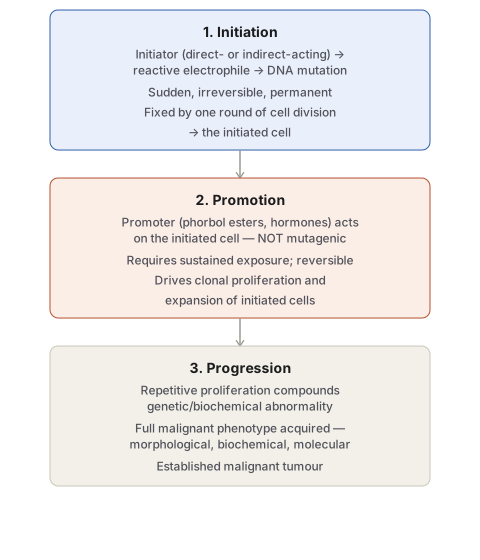
Initiation
The first stage, induced by an initiator carcinogen, producing a sudden, irreversible, permanent change — a single dose can suffice, though larger/longer exposure is more effective. Initiators fall into two categories:
- Direct-acting carcinogens — require no prior metabolic activation (e.g. alkylating agents, acylating agents).
- Indirect-acting carcinogens (procarcinogens) — require metabolic conversion to an “ultimate carcinogen” (polycyclic aromatic hydrocarbons, aromatic amines, azo dyes, and most naturally-occurring carcinogens fall here — the larger category).
Steps common to both: (1) metabolic activation (indirect-acting carcinogens only, chiefly via hepatic cytochrome P-450 mono-oxygenases; carcinogenic potency depends on the balance of activation vs detoxification reactions, and on host genotype — e.g. individuals carrying the CYP1A1 susceptibility genotype have markedly higher lung cancer risk even as light smokers); (2) generation of reactive electrophiles (direct-acting carcinogens are intrinsically electrophilic; indirect-acting carcinogens become electron-deficient after activation) that bind electron-rich cellular molecules; (3) DNA as the primary target, producing mutagenesis — damage that may be repaired (failure of this repair, as in xeroderma pigmentosum, a hereditary DNA-repair defect, predisposes to skin cancer) or, if unrepaired, becomes fixed; the most frequently affected genes are RAS (oncogene) and p53 (anti-oncogene). (4) The initiated cell: unrepaired DNA damage becomes permanent and heritable only once the altered cell undergoes at least one round of proliferation — the stimulus for this division may come from tissue regeneration, dietary factors, hormone-driven hyperplasia, or viral infection (e.g. hepatocellular carcinoma following viral hepatitis, endometrial carcinoma following endometrial hyperplasia, oestrogen’s role in breast cancer).
Promotion
Promoters (phorbol esters, phenols, certain hormones, drugs such as phenobarbital) act on already-initiated cells and differ fundamentally from initiators: they produce no sudden change, require sustained application/administration after initiator exposure, produce reversible change, are not mutagenic (do not damage DNA directly), and act instead by driving clonal proliferation and expansion of the initiated (already mutated) cell population — often exploiting reduced growth factor dependence after RAS mutation. Sustained initiator exposure alone, without any subsequent promoter, can still produce cancer; but promoter exposure alone, or promoter application before initiator exposure, cannot transform a cell — sequence matters.
Progression
The stage at which the proliferating, mutated cell clone acquires the full phenotypic features of malignancy — morphological, biochemical and molecular — as the initiated cell’s progeny, through repetitive proliferation, inherit and compound the genetic and biochemical characteristics of malignant transformation.
Chemical Carcinogens in Humans
Initiator Carcinogens
Direct-acting (no metabolic activation needed, weakly carcinogenic, implicated chiefly in leukaemia/lymphoma):
- Alkylating agents — cyclophosphamide, chlorambucil, busulfan, melphalan, nitrosourea (paradoxically, several are themselves chemotherapy drugs) — lymphoma, AML.
- Acylating agents — acetyl imidazole, dimethyl carbamyl chloride.
Indirect-acting (procarcinogens) — the larger group, requiring metabolic activation:
- Polycyclic aromatic hydrocarbons — the largest procarcinogen category (anthracenes, benzapyrene, methylcholanthrene), from tobacco combustion/chewing, smoke, fossil fuel, soot, tar, mineral oil, smoked food, industrial/atmospheric pollution. Effect depends on exposure route: topical → skin cancer, subcutaneous → sarcoma, inhalation → lung cancer. Notable examples: 20-fold higher lung cancer risk in heavy smokers (2 packs/day for 20 years); kangri cancer — abdominal wall skin cancer in Kashmiris from carrying a hot-ember pot (kangri) against the abdomen; oral cavity cancer from tobacco/betel-nut chewing, and specifically from chutta reversed-smoking (lit end in mouth) practised in Andhra Pradesh.
- Aromatic amines and azo dyes — β-naphthylamine and benzidine (bladder cancer, notably in aniline dye/rubber industry workers), azo dyes used as food colourants (butter yellow, scarlet red — hepatocellular carcinoma).
- Naturally-occurring products — aflatoxin B1 (from Aspergillus flavus in stored grain, the most important, causing hepatocellular carcinoma especially with concurrent hepatitis B), actinomycin D, mitomycin C, safrole, betel nuts.
- Miscellaneous — nitrosamines/nitrosamides (formed in the stomach by nitrosylation of food preservatives — gastric carcinoma); vinyl chloride monomer (hepatic angiosarcoma); asbestos (bronchogenic carcinoma, mesothelioma, especially with concurrent smoking); arsenicals (epidermal hyperplasia, basal cell carcinoma); industrial metals — nickel, lead, cobalt, chromium (lung cancer); insecticides/fungicides and saccharin/cyclamates (carcinogenic in experimental animals, human evidence weaker).
Promoter Carcinogens
Lack intrinsic carcinogenic potential but enhance proliferation of already-initiated cells: phorbol esters (TPA, the best-characterised experimental promoter, acting via signal induction protein activation); hormones (endogenous/exogenous oestrogen excess promoting endometrial and breast cancer; diethylstilbestrol exposure causing postmenopausal endometrial carcinoma and, in daughters exposed in utero, vaginal clear cell carcinoma); and miscellaneous factors (dietary fat in colon cancer, cigarette smoke, viral infection).
Testing for Chemical Carcinogenicity
Two principal methods: experimental induction in animals (the traditional approach), and the Ames test — an in vitro bacterial mutagenesis assay used as a rapid screen, since most chemical carcinogens are also mutagens.
Clinical Relevance
- Understanding that initiation is irreversible while promotion is reversible has direct public health application: removing exposure to a promoter (e.g. stopping smoking, reducing dietary fat, treating hormonal excess) can meaningfully reduce cancer risk in an already-initiated population, even though the initiating mutation itself cannot be undone.
- The regional, culturally specific examples (kangri cancer, chutta-related oral cancer, betel-nut chewing) are a reminder that carcinogen exposure and cancer patterns are strongly shaped by local habits and occupational practices, which is directly relevant to counselling patients about modifiable risk in the specific population being treated.
- Aflatoxin B1’s synergy with hepatitis B in causing hepatocellular carcinoma is a clinically important gene-environment(-infection) interaction — the combined risk in a hepatitis B carrier with aflatoxin exposure substantially exceeds either risk factor alone, relevant to HCC surveillance strategy in endemic regions.
- Recognising xeroderma pigmentosum as a DNA-repair-defect disease that fails specifically at the “unrepaired damage becomes fixed” step of initiation explains why these patients develop skin cancer from ordinary UV/chemical exposure that would be safely repaired in a normal individual.
Diagram 1: Stages of Chemical Carcinogenesis
Draw a single downward column of three stages, each contrasted on the properties that distinguish it from its neighbour.
- Initiation — sudden, irreversible, permanent DNA mutation; requires only one round of cell division to fix; produces the “initiated cell.”
- Promotion — non-mutagenic, reversible, requires sustained exposure after initiation; drives clonal expansion of the initiated cell population specifically.
- Progression — repetitive proliferation compounds the abnormality into the full malignant phenotype.
Labels required
- Initiation and promotion must each be labelled with their reversibility (irreversible vs reversible) and their mutagenic status (mutagenic vs non-mutagenic), since these are the two properties most often used to test whether a student can distinguish the two stages.
- The requirement that promotion act specifically after initiation — and that promotion alone cannot transform a normal cell — should be noted as a side annotation, since sequence-dependence is a frequently tested nuance.
Errors commonly made
- Describing promoters as weaker initiators rather than as a mechanistically distinct category that does not damage DNA at all — a promoter cannot start carcinogenesis on its own, no matter the dose or duration.
- Omitting the “at least one round of cell division” requirement for initiation to become fixed, which is why removing the carcinogen before the initiated cell divides can still prevent transformation.
My Sticky Notes
Personal revision notes, mnemonics and reminders.
