
Blood Groups and Transfusion Medicine
Overview
Landsteiner described ABO 1900 (Nobel 1930). Blood group = inherited RBC antigen system. >20 systems, ~400 antigens, but ABO+Rh clinically major.
Antibodies: naturally-occurring (anti-A/anti-B, IgM, present if antigen absent, never transfused) vs immune (acquired via transfusion/pregnancy, IgG, warm).
ABO system
3 alleles (A, B, O), chromosome 9.
| Group | RBC antigen | Serum antibody |
|---|---|---|
| AB | AB | None |
| A | A | Anti-B |
| B | B | Anti-A |
| O | none | Anti-A, Anti-B |
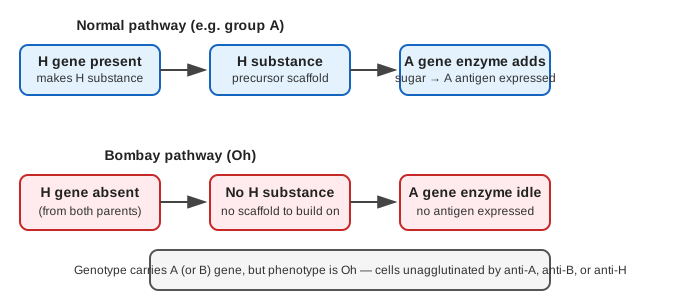
H substance/Bombay phenotype: O and A2 cells carry lots of H substance (precursor of A/B antigens). Person who inherits A/B gene but no H gene from either parent = Oh/Bombay group — has anti-A, anti-B, AND anti-H, but cells not agglutinated by any antisera (H substance itself missing, so A/B can’t be built).
Rh system
C/c, D/d, E/e genes, chromosome 1. Only D antigen exists (no d). D = most immunogenic, clinically important. D+ = Rh+, D- = Rh-.
NO naturally-occurring Rh antibodies — all acquired (transfusion/pregnancy). Explains why Rh HDN needs prior sensitisation, doesn’t happen on first pregnancy.
Transfusion process (sequential)
- Donor selection (Hb >12.5g/dl, infection-free)
- Collection (sterile bag + anticoagulant e.g. acid citrate)
- Storage (2-6°C)
- Donor testing (ABO-Rh + HBV/HCV/syphilis/malaria screen)
- Recipient ABO-Rh grouping
- Compatibility testing (antibody screen + cross-match)
- Supervised transfusion
Blood components
Whole blood → low-speed spin → packed RBCs + PRP → high-speed spin → platelets + FFP. Cryoprecipitate = thawed FFP + spin. Apheresis = direct single-donor platelet collection.
| Component | Use | Effect |
|---|---|---|
| Packed RBCs | Normovolaemic anaemia, no cardiac disease | +1g/dl Hb per unit |
| Platelets | Thrombocytopenia + bleeding (<10,000/µl) | +5,000-10,000/µl per unit |
| FFP | Coagulation failure, TTP | +2% factors per unit |
| Cryoprecipitate | Concentrated factor VIII/vWF/fibrinogen | — |
Complications (5-6% of transfusions)
Immunologic:
- Haemolytic reactions — intravascular (rapid, ABO incompatibility, complement fixation, restlessness→shock/renal failure) vs extravascular (Rh antibodies, milder, malaise+fever) vs delayed (anaemia ~1wk later, anamnestic response)
- TRALI — donor anti-HLA Ab → recipient leucocyte aggregation in lung microvasculature → pulmonary oedema/respiratory failure
- Febrile/allergic/anaphylactic (anti-IgA), urticaria, transfusion GVHD (donor T cells)
Non-immune:
- Circulatory overload — MOST COMMON/IMPORTANT complication; risk high in chronic anaemia, infants, elderly
- Massive transfusion — dilutional thrombocytopenia + factor dilution
- Infection transmission (HBV, HCV, CMV, syphilis, malaria, HIV etc.) — mandatory screening required
- Air embolism — rare with modern negative-pressure bags
- Thrombophlebitis — more with ankle (saphenous) site, >12hr single-site transfusion
- Transfusion haemosiderosis — repeated transfusion without blood loss (thalassaemia major); 250mg iron/unit vs 1mg/day excretion → organ damage after ~100 units
Clinical relevance
Bombay phenotype = elegant epistasis example — H gene sits upstream of A/B expression, so its absence masks A/B genotype entirely serologically. Rh’s lack of naturally-occurring antibodies explains why Rh HDN needs prior sensitisation (never on first incompatible pregnancy). Circulatory overload (not haemolytic reaction) is actually the leading transfusion complication/death cause — often underestimated. Transfusion haemosiderosis arithmetic explains why iron chelation is mandatory in long-term thalassaemia major management, not optional precaution.
Overview
Karl Landsteiner described the major human blood groups in 1900 (Nobel Prize, 1930). A blood group is any well-defined system of inherited red cell antigens — over 20 systems, roughly 400 antigens, are recognised, but the ABO and Rhesus (Rh) systems carry the major clinical significance. Minor systems (Lewis, P, I, MNS, Kell, Duffy, Lutheran) are of lesser clinical importance.
Antibodies against red cell antigens come in two forms:
- Naturally-occurring antibodies — present in individuals who lack the corresponding antigen and have never been transfused; the most important are anti-A and anti-B, usually IgM.
- Immune antibodies — acquired through transfusion or transplacental passage during pregnancy; these are warm antibodies, usually IgG.
The ABO System
Three major allelic genes — A, B, O — on the long arm of chromosome 9, controlling synthesis of the A and B antigens. Serum naturally contains antibodies against whichever antigen(s) are absent from that person’s own red cells:
| Blood group | Antigens on red cells | Naturally-occurring serum antibodies |
|---|---|---|
| AB | AB | None |
| A | A | Anti-B |
| B | B | Anti-A |
| O | O (none of A/B) | Anti-A, Anti-B |
Two subgroups of A (A1, A2 — and correspondingly A1B, A2B) exist but are of minor clinical significance. Routine typing tests red cells against anti-A/anti-B sera, and serum against A, B, and O red cells.
H substance and the Bombay phenotype: red cells of type O and A2 carry large amounts of the H substance, a genetically distinct precursor of the A and B antigens. An individual who inherits an A or B gene but fails to inherit the H gene from either parent is the rare Oh (Bombay) blood group — despite carrying all three antibodies (anti-A, anti-B, and anti-H) in serum, the red cells are not agglutinated by standard antisera, because the H substance itself (the precursor needed to build A/B antigens in the first place) is absent.
The Rhesus (Rh) System
Discovered using antisera raised by immunising rabbits with Rhesus monkey red cells. Rh allelic genes — C/c, D/d, E/e — are on chromosome 1; one set of three is inherited from each parent, giving complex combinations. Only a D antigen exists (no “d” antigen). Of these, D is the most strongly immunogenic and clinically most important; routine Rh grouping uses anti-D antiserum — D-positive = Rh-positive, D-negative = Rh-negative.
Unlike ABO, there are no naturally-occurring Rh antibodies — all Rh antibodies in Rh-negative individuals are acquired through immunisation (transfusion or pregnancy), which is why Rh incompatibility causes haemolytic transfusion reactions and haemolytic disease of the newborn on second exposure, not the first.
Blood Transfusion — Sequential Process
- Donor selection — healthy, haemoglobin >12.5 g/dl, free of infectious disease.
- Collection — phlebotomy into a sterile plastic bag with anticoagulant (commonly acid citrate), gently mixed as blood flows in.
- Storage — refrigerated at 2–6°C.
- Donor testing — ABO-Rh grouping, plus screening for HBV, HBsAg, HCV, syphilis, and malaria.
- Recipient blood grouping — ABO-Rh.
- Pre-transfusion compatibility testing — antibody screening of the recipient’s serum for clinically significant antibodies, followed by cross-matching the recipient’s serum against donor red cells.
- Supervised transfusion — observed for reactions.
Beyond whole blood, modern blood banking allows transfusion of individual components: packed RBCs, platelets, WBC concentrates, plasma components, and plasmapheresis products, each matched to specific clinical situations.
Blood Components — Preparation and Use
Whole blood is centrifuged at low speed into packed RBCs and platelet-rich plasma (PRP); PRP is then centrifuged at high speed into random donor platelets and fresh-frozen plasma (FFP). Cryoprecipitate comes from thawing FFP followed by centrifugation. Apheresis collects a large excess of platelets directly from a single donor.
| Component | Use | Effect |
|---|---|---|
| Packed RBCs | Raise oxygen-carrying capacity in normovolaemic anaemic patients without cardiac disease | 1 unit raises Hb by ~1 g/dl |
| Platelets | Thrombocytopenic patients with haemorrhage (optimal threshold: count <10,000/µl) | 1 unit raises count by 5,000–10,000/µl |
| Fresh-frozen plasma | Coagulation failure, TTP (contains albumin, protein C/S, antithrombin, coagulation factors) | 1 unit raises coagulation factors by ~2% |
| Cryoprecipitate | Sources of concentrated factor VIII/vWF/fibrinogen | — |
Complications of Blood Transfusion
Occur in 5–6% of transfusions; most are minor, some serious or fatal. Classified as immunologic and non-immune.
A. Immunologic Transfusion Reactions
- Haemolytic transfusion reactions — immediate or delayed, intravascular or extravascular.
- Intravascular haemolysis (very rapid) — usually ABO incompatibility, since both naturally-occurring anti-A and anti-B fix complement. Symptoms: restlessness, anxiety, flushing, chest/lumbar pain, tachypnoea, tachycardia, nausea, progressing to shock and renal failure.
- Extravascular haemolysis — usually from immune antibodies of the Rh system; milder, typically malaise and fever, though shock/renal failure can rarely occur.
- Delayed reactions — anaemia from RE-system red cell destruction about a week post-transfusion, generally from an anamnestic response following prior transfusion or pregnancy.
- Transfusion-related acute lung injury (TRALI) — uncommon; donor plasma with high anti-HLA antibody titres binds recipient leucocytes, which aggregate in the pulmonary microvasculature and release mediators of increased vascular permeability, causing acute pulmonary oedema and respiratory failure.
- Other allergic reactions — febrile reactions (immunologic reaction against WBCs, platelets, or IgA); anaphylactic shock in patients with anti-IgA antibodies; urticaria; transfusion-related graft-versus-host disease (mediated by donor T lymphocytes).
B. Non-Immune Transfusion Reactions
- Circulatory overload — the single most common and most important transfusion complication, causing pulmonary congestion and acute heart failure; highest risk in chronic anaemia, infants, and the elderly; onset immediate or delayed up to 24 hours.
- Massive transfusion — stored-blood volume exceeding the patient’s normal blood volume causes dilutional thrombocytopenia and dilution of coagulation factors.
- Transmission of infection — hepatitis (HBV, HCV), CMV, syphilis, malaria, toxoplasmosis, infectious mononucleosis, brucellosis, HIV; risk rises with repeated transfusion (haemophilia, thalassaemia major, acute leukaemia, severe haemorrhage), which is why mandatory screening (HIV, HBV, HCV, syphilis, malarial parasite) precedes every unit.
- Air embolism — unlikely with modern negative-pressure plastic bags; a debilitated patient can develop symptoms from as little as 10–40 ml of air, though healthy individuals tolerate it better.
- Thrombophlebitis — more common with venesection at the saphenous vein (ankle) than arm veins, and with transfusion continued beyond 12 hours at a single site.
- Transfusion haemosiderosis — post-transfusion iron overload from repeated transfusion without blood loss (thalassaemia major, severe chronic refractory anaemia); the body can only excrete ~1 mg iron/day while one unit of whole blood carries ~250 mg — after roughly 100 units, liver, myocardium, and endocrine glands sustain damage.
Clinical Relevance
- The Bombay phenotype is a genuinely elegant teaching example of epistasis in blood group genetics — the H gene sits upstream of A/B expression, so its absence masks an inherited A or B genotype entirely at the phenotypic (serologic) level, producing a person whose red cells behave like a “universal non-recipient” despite carrying A/B genes.
- The Rh system’s lack of naturally-occurring antibodies (versus ABO’s naturally-occurring anti-A/anti-B) is the direct explanation for why Rh haemolytic disease of the newborn requires prior maternal sensitisation — it essentially never happens on a first Rh-incompatible pregnancy, only subsequent ones.
- Circulatory overload being the leading cause of transfusion-related complications and death (ahead of the more commonly emphasised haemolytic reactions) is a frequently underestimated fact clinically, particularly relevant in chronic anaemia patients who may need slower transfusion rates or diuretic cover.
- Transfusion haemosiderosis is not a hypothetical risk but the eventual dominant clinical problem in adequately transfused thalassaemia major patients — the arithmetic (250 mg iron/unit vs 1 mg/day excretion capacity) explains why iron chelation therapy is a mandatory part of long-term thalassaemia management, not merely a precaution.
Diagram 1: Bombay Phenotype — H Substance Pathway
Draw two parallel three-step chains, one above the other, for direct comparison.
Normal (e.g. group A): H gene present → H substance made → A-gene enzyme adds sugar to H substance → A antigen expressed.
Bombay (Oh): H gene absent (both parents) → no H substance → A-gene enzyme has nothing to act on → no antigen expressed.
Close with a single summary box: genotype carries the A (or B) gene, but phenotype is Oh — cells unagglutinated by anti-A, anti-B, or anti-H.
Labels required
- The H substance must be explicitly labelled as a precursor scaffold, not simply “another antigen” — the entire point of the diagram is that it’s a substrate the A/B enzymes act upon, not an independent endpoint.
- Both chains must show the same A-gene enzyme step, differing only in whether a substrate is available — this is what makes clear the defect is upstream (H gene), not in the A/B gene itself.
Errors commonly made
- Describing Bombay phenotype as if the A or B gene itself is absent or mutated — it is present and functional; the defect is entirely upstream, in the H gene supplying the substrate.
- Forgetting that Bombay individuals carry anti-H in addition to anti-A and anti-B — a point easy to omit since anti-H is not part of the standard ABO antibody teaching.
Short Essays (1)
Short Answers (1)
Multiple Choice Questions (3)
My Sticky Notes
Personal revision notes, mnemonics and reminders.
